Guest Blogger – The Retirement of the Baby Boomers….real or fantasy?

My initial thoughts on the pending dilemma of retiring Baby Boomers within my industry were that of alarm.  The knowledge and skill set that would be lost is an  issue that most US institutions face daily.  My background is in the engineering field where I have always worked with the Utility, Industrial, and Government markets.

 Therefore, when I work for a company that averages 36% of their workforce being Baby Boomers, I find myself cringing.  Anyone who works in a diverse age group of people (or to be politically correct, we’ll call it a “multigenerational” workforce) know that these work environments can breed misunderstanding and conflict and may compromise growth.

And as I begun thinking this dilemma through, a few points cropped in this crazy blonde brain of mine….that’s right, I do have real moments of clarity at times!

  1. With the financial and economic crisis these past few years, many soon-to-be retirees are choosing to stay employed.
  2. The trend of salaries for Baby Boomers is significantly higher than that of entry level employees.  Therefore, my company is noticing a decrease in project awards due to the fact we are out pricing ourselves with our competitors.
  3. With the Baby Boomers continuing to work longer, we are not bringing in younger employees to mentor out of college.  The employee pool is becoming stagnant. 

So what is the answer?  Is the issue of retiring Baby Boomers really a crisis or is it just an adjustment period for employers to incorporate new blood?  Dave Bernard of U.S. News stated that retirement can be a time to explore creative new avenues, and put the skills you have cultivated throughout your career to work in new ways (June, 2012). 

He is dead on when I notice that many retirees are returning back into the engineering field as “consultants” or they are reducing their hours to continue their insurance coverage and reducing their pace a little.

However, the demands on today’s knowledge workers are more mental than physical. Many baby boomers, who have already begun to reach age 65, are far from physically exhausted and often have much more to give (Bernard, 2012).  

Whatever happens, the baby boom retirement crisis is bound to have its unexpected turns. As they age, they’ll surely continue to change the economy, though the effects are hard to predict (Gelinas, 2011).   Employers today must strategize on how to best incorporate the knowledge skills from these employees through Mentoring programs or Internships. 

Ultimately, we must stay competitive in the marketplace to keep the jobs here at home.  

References:

Bernard, D. (2012, June).  Baby Boomers Search for Second Careers.  U.S. News.  (http://money.usnews.com/money/blogs/On-Retirement/2012/06/01/baby-boomers-search-for-second-careers).  

Gelinas, N. (2011, November).  As baby boomers retire, the times will be a-changin.’   The Los Angeles Times.  (http://articles.latimes.com/2011/nov/06/opinion/la-oe-gelinas-baby-boomers-retire-20111106).

Please share your comments with this industry leader.

ABOUT THE BLOGGER

 

Brandi Reilly currently works for Mesa Associates, Inc., a multidiscipline engineering design firm based out of Knoxville, TN.   Her experience spans 16 years in engineering, project management, and consulting services.  She graduated from Clemson University with a Bachelor’s degree in Environmental Engineering and recently completed her MBA at Lincoln Memorial University in 2011.  She has completed her Project Management Professional (PMP) accreditation and is currently pursuing her Professional Engineering (PE) license.  

(c) 2012 by Dr. Daryl D. Green

Spotlight on Industry Expert – Caesar Andrews

Periodically, NuLeadership Revolution discusses emerging trends with an industry expert.  We are happy to talk with Caesar Andrews this week.

Tell our audience a little about yourself.

My current adventure is in journalism education. Teaching ethics, writing and editing courses. Most recently at the University of Nevada, Reno. My transition to the classroom follows years of work in newsrooms.

 How did you start your career in this industry?

Interest in news goes back to high school. I majored in journalism at Grambling State University in Louisiana, with many hours spent working on the campus newspaper – great experience.

When first hired as a staff writer in Cocoa, Fla., I figured I would report for a few years, then move on to some other field of interest. Well, “a few years” turned into about 30 with the same company.

I did not start out feeling journalism was some kind of lifelong destination for me. But I ended up loving the work and the challenges (most days) and the many ways journalists get to witness so much of the world.  

Discuss your experience working in your industry.

I was fortunate to work with many talented people. I was fortunate to be part of newsrooms covering major events –launch of the first space shuttles, national political conventions, the Sept. 11 attacks, sports championships, and more. I likewise appreciated the impact of covering local community news.

I was able to work in markets big and small, from a weekly in Florida, where I was first promoted to manager, to the start-up staff at the national daily USA TODAY.

Other career stops were Lansdale, Pa., suburban New York, a news bureau in Washington, D.C., and Michigan, where I completed my Gannett Co. career in 2008 as executive editor of the Detroit Free Press. 

I enjoyed the improvisation found in newsrooms. Even during calm periods, breaking news was always on the verge of happening at any moment. A major project or something small but meaningful was always working its way toward publication.

Journalism is a great match for those with an appetite for constant learning. Lessons can be found all over. From sources. From an often critical public. From many wise souls who populate newsrooms.

And certainly from mistakes – the most painful ones can end up making you stronger. Even the knuckleheads encountered can play an educational role. An awful lot can be learned by observing what not to say, what not to do, and how not to be. 

What are some industry challenges over the next several years?

For traditional news media gatekeepers, the old iron grip on access to information and on steady growth in ad dollars is gone. For most consumers, unending streams of words, images, audio and video on almost any conceivable topic are just a click away.

Large portions of this information come from providers who do not label themselves professional journalists. But the impact on those who are journalists is unmistakable.

News organizations as well as individual news professionals are forced to sharpen their sense of purpose. The smart ones concentrate on making what they offer even more distinct. They specialize in content that extends beyond what readers, viewers and listeners can easily get elsewhere. 

Mastering the right delivery technology is one challenge, as more and more people bypass printed news pages and traditional network newscasts.  

Managing the clash of company motivations is another big challenge. Serving the civic good AND making a profit that sustains the business have to be reconciled. 

Tension between noble purpose and profit margins is not new, just more painfully apparent in this period of economic turmoil for traditional media. 

What steps are market leaders in your field doing to address these problems to ensure sustained success?

Media companies are fiercely rethinking how to thrive under new rules of the road. Not all will survive, as is the case in other fields disrupted by massive shifts in revenue, technology and other marketplace fundamentals. But there is no shortage of initiatives:

  • Every serious media organization is rewriting strategies. They are rethinking news content for digital users, refining their pitches to advertisers, and pushing to charge users for information consumed online.
  • Newsrooms are seeking workers who help identify and connect with targeted audiences. The best job applicants come armed with digital awareness.
  • Media organizations are consolidating, collaborating and remaking themselves in ways unimaginable not long ago. This is all driven by the need to reconsider traditional boundaries, especially as audiences, and therefore advertisers, dramatically change their patterns of media consumption.
  • Newsrooms are making use of more citizen contributors. Modern consumers expect wide-ranging interaction through media, not just old-style, one-way presentation of news. Citizens’ blogs, reviews, commentary and ubiquitous public comments online have altered the community conversation.

 What tips would you give individuals interested in getting into your industry as a new prospective employee?

Treat development of skills as if mining for gold. Place high value on curiosity.

Prepare to take on different opportunities, whether with established companies, or innovative start-ups, or as a freelancer, or in some other customized role you choose to create.

Any additional insight you would like to discuss?

The finest journalists hold on to some timeless principles that do not go out of style. They tell compelling stories that ought to be told. They practice the art of personal credibility.

Please share your comments with this industry leader.

(c) 2012 by Dr. Daryl D. Green

Caesar Andrews is a visiting professor in the Reynolds School of Journalism, University of Nevada, Reno. He holds the Paul A. Leonard Distinguished Visiting Chair for Ethics and Writing in Journalism at UNR. 

Previous visiting professorships were completed at Washington and Lee University in Lexington, Va., Arizona State University, Phoenix, and at  his alma mater, Grambling State University, Grambling, La. 

Andrews worked as a senior editor for the Gannett Co. for nearly 30 years, most recently at the Detroit Free Press and previously at newsrooms in Washington, D.C., New York, Pennsylvania and Florida.  He is a former president of the Associated Press Managing Editors and was an officer in the American Society of Newspaper Editors. 

He serves on the boards of directors for the Council for Higher Education Accreditation and for the Student Press Law Center.

Demising the American Living Wage

Are you worried about your children and grandchildren’s future in terms of a better life?  You should be!  Market forces will make it harder for individuals to make an honest wage.  American companies, once loyal to their employees, have abandoned the social contract with their employees.  

Leaving today’s workers vulnerable to the consequences of globalization.  Thomas Friedman, author of The World is Flat, notes ‘The best companies outsource to win, not to shrink. They outsource to innovate faster and more cheaply in order to grow larger, gain market share, and hire more and different specialists—not to save money by firing more people.”  

Sadly, most companies do not have this long-term perspective about globalization.  In hindsight, globalization may produce a more equitable average wage across the world, while reducing the earning power of developed countries and increasing the living wages for emerging countries.  These realities on living wages are a critical concern for most Americans.  

Since the recession in 2008, U.S. businesses have posted historical profits even while unemployment has risen.  Consequently, the market place is saturated with seasoned individuals who are willing to take massive pay cuts in order to obtain a secure job.  Employers understand that it is a buyer’s market where employers can be picky. This reality has bottlenecked millions of young college grads who must fight for entry level jobs with career veterans.  

According to a Manpower Group analysis, 52% of U.S. employers state they have a difficult time filing positions because of talent shortage.   Peter Cappelli, author of Why Good People Can’t Get Jobs, outlines the hypocrisy of most employers:  “With an abundance of workers to choose from, employers are demanding more of job candidates than ever before.…To get a job, you have to have that job already. It’s a Catch-22 situation for workers—and it hurting companies and the economy.”  Employers are setting unrealistic hiring expectations and offering low wages.  

People, from every country, seek to earn a living to sustain themselves, by taking care of their basic needs.  According to the United Nations’ Millennium Development Report, more than1 billion people on the globe live on less than $1 a day.  

Ironically, as most Americans have watched their wages decrease, most other workers across the globe sees a significant increase.  The world’s middle income class earns between $700 to $7,500 per family member. Consequently, individuals making more than $7,500 are considered part of the global affluent class.   

Some experts argue that globalization has eroded America’s standard of living, especially during the resurgence of manufacturing.  Economist Gordon Hanson notes, “The U.S. has held manufacturing wages in check while there has been strong wage growth in China and moderate wage growth in Mexico.  

With high unemployment and fierce global competition, manufacturing companies has used this fact to their advantage.  This reality has forced two-tier contracts with unions to pay new hires less than existing workers and reduce new hires’ benefits.  In 2010 and 2011, new hires (manufacturing of durable goods) who had three years or more of experience, were paid an average of .3% less than workers in 2007 and 2008. 

Today’s American workers are finding it difficult to make ends meet. According to the Pew Charity study, economic mobility will be more difficult for individuals, especially depending on where they live.  Economic mobility relates to the ability of a person to move up or down the economy ladder.  

The Pew study concluded that people living in Louisiana, Oklahoma, South Carolina, Alabama, Florida, Mississippi, North Carolina, and Texas would be less likely to improve their economic standing.  However, states such as Maryland, New York, and Pennsylvania would have a better chance of economic mobility due to higher wages in manufacturing and public jobs.  

While the poorest American class wouldn’t consider itself part of an affluent class, this relative inequality of incomes is a bitter pill from citizens of poorer countries.  According to an UN study, the poorest countries across the globe consume 14% of the planet’s resources while 20% of the richest countries with the industrialized nations (including the United States) consume 86% of resources.  

Due to globalization, economic mobility will produce a variety of winners and losers.  Consequently, social mobility becomes more difficult as Americans are forced into a caste system of unemployed or underemployed workers. 

What will happen to economic mobility in America? Will the inequality of wages for global workers create new problems for businesses and society at large?                                                                                              

 © 2012 by Daryl D. Green                                    


Global Production Collision

Racing through the parking lot at work, I carry out my ritual of counting import versus domestic cars.  Like the Olympics, I hope that the home team would win.  During my ritual, domestic cars often lose to their foreign competitors in the number of cars. However, it would be difficult to identify what an American product is because of the transformation of the world due to globalization.

In June, the Dow Jones Industrial Average sank into the red for the year after a dismal U.S. job report. Stocks globally have been on a downward spiral since the beginning of May due to worries about Europe’s debt troubles and China’s economic engine which has begun to stall.  Many people hope that companies like General Motors can jumpstart the American economy.  

Like Detroit, Knoxville would embrace the return of the manufacturing industry.  According to a recent Brookings Institute report, “Locating American Manufacturing: Trends in the Geography of Production,” manufacturing jobs in the Knoxville Metropolitan area increased 9.9% from 2010 to 2011. 

In fact, this manufacturing gain was more than 3 times the national average, ranking Knoxville 6th in the nation.  However, many globalization critics argue that weak international trade agreements destroy manufacturing jobs in developed countries like the United States.  The net results are American businesses move operations to countries with cheaper labor.  

Charles Hills, author of International Business, argues, “In the past few years, the same fears have been applied to services, which have increasingly been outsourced to nations with lower labor costs.” Most businesses attempt to stimulate growth through a variety of efforts, including technology investments, acquisitions, and major market campaigns. Companies hope that customers will purchase their products and services due to the value component. 

Robert Jacobs, Richard Chase, and Nicholas Aquilano, authors of Operations & Supply Management remark, “Companies today have found how essential great operations and supply management are to the success of the firm.” 

However, globalization has further linked the financial welfare of each country’s constituents.  In May of 2012, HP announced it would slash more than 27,000 jobs, which is 8% of its worldwide workforce by 2014 in hopes of saving billions of dollars against fierce competition.  

It is the largest restructuring campaign in HP’s 73 year old history. At the time, former HP CEO Meg Whitman stated restructuring was “absolutely critical for the long-term success of the company.”  The downsizing of HP’s workforce was the third largest in tech history.  However, other high tech companies have also been impacted.  IBM downsized 60,000 jobs and AT&T downsized 40,000 employees in the mid-90s. 

At the same time of dealing with global production, each country seeks to increase exports of goods while spearheading job creation in their own markets.

With globalization upon us, can domestic products be considered American when some components are made abroad? Please share your opinion on this topic. 

© 2012 by Daryl D. Green

Stopping the Global Crisis

Last week, I received news that I was going global.  It was exciting news. Aren’t we interconnected anyway?  My primary publisher, Createspace, announced that my books would now be available directly through Amazon’s European websites, including Amazon.co.uk, Amazon.de, Amazon.fr, Amazon.es, and Amazon.it.

As the world’s largest online retailer, Amazon.com is the parent company of Createspace Publisher.  Globalization has connected our lives together.  If organizations are going to be successful in the future, they need to be strategic. Finding talent and solutions will be vital, regardless of the continent.  

Globalization prevents us from hiding out in our countries. With the issues of austerity in Europe and threats in Iran, organizations are struggling to stay ahead of all the significant changes.  Global turbulence continues to haunt financial institutions.

Most economic experts believe that Europe is in recession. According to Britain’s Office for National Statistics, the first quarter of this year Britain’s economy shrank .2%, after having contracted .3% in the fourth quarter of 2011. Europe struggles to maintain financial stability while country after country falters.  Greece, Spain, Portugal, and Italy lead the list of financially crippled countries in Europe.  

Around the world, countries continue to suffer from unprecedented changes. The year 2011 was a vintage time for massive protests, from the awakening of the Arab world to the defeat of evil tyrants. Japan suffered its biggest nuclear catastrophe. 

Egypt is now crippled by economic turmoil, inadequate health care, and continued unrest in the country.  In fact, the country is headed toward another milestone as Egyptians decide who will be their president and architect for leading them into the future.  

Voters may elect to move toward an established Islamic nation; this fact is driven by religious clerics and other influential parties who desire a more religious country. 

Shady Ghoneim, an Egyptian importer, worries about the country’s political fate internationally: “Foreign investors won’t come back unless they can trust a moderate president.”  Troubles in one country can have a negative impact to other nations due to these financial linkages. 

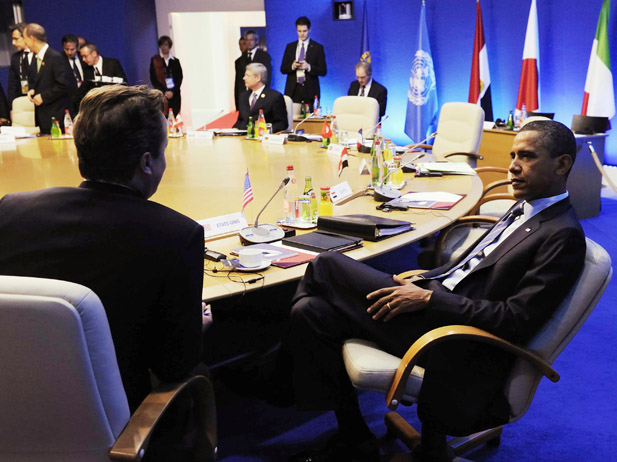
The United States and other members of the Group of Eight (G-8) industrial nations (Germany, France, Canada, United States, Britain, Italy, Russia, and Japan) are attempting to assist Europe’s financial crisis. 

President Barack Obama discussed the ramification during an upcoming meeting: “All of us are absolutely committed to making sure that the growth and stability and fiscal consolidation are part of the overall package.” However, many citizens from these European countries resist any financial solutions (i.e. austerity measures) that will take away their quality of life.

At the same time of dealing with the global financial crisis, each country seeks to increase exports of goods and spearheading job creation in their own countries. Therefore, foreign government officials are in a risky situation by supporting any international agreed solutions which are very unpopular with their own citizens. 

Since globalization has linked each country economically, Americans cannot escape either.  Regardless of the continent, people are looking for answers. Thus, countries must promote mutual financial interest internationally while keeping a pulse of their own self interest.   Therefore, countries with an isolationistic mindset will have a difficult time navigating in the future. 

Please share your opinion on this topic. 

 © 2012 by Daryl D. Green                                    


Relationship Selling Toward Greater Profitability in the Future

Is America in trouble?  On a daily basis we are being required to answer that question both subconsciously and openly by today’s media pundits.  Recent economic reports have shown vulnerabilities in the United States economic engine including everything from manufacturing to consumer spending. 

Even the latest positive economic news brings another sequence of gloom. For example, the job rate ticked down in July, 2011; however, American businesses are not creating enough jobs. With unemployment still hovering over 9%, most people do not feel there  is much to be happy about related to the job outlook.    

One of the smartest ways to retool the economy is by selling more products and services to domestic and international markets.  Therefore, the art of selling becomes a critical competitive advantage to organizations that want to sustain profitability over the long-term. Selling is a common denominator for every business. No matter what business you are in, you must sell your product or services to customers. 

Yet, the concept of selling is related to creating value for customers.  When a bakery gives an extra donut in a dozen, the company is adding value and fosters better relationships with customers.  Given these realities, selling is a people-oriented business that addresses the customer value proposition. 

Relationship skills can make or break important connections.  Dr. Dave Hinkes, co-author of Selling by Objectives: The Handbook for More Profitability in the 21st Century, often advises his Fortune 500 clients to stay connected with their customers.  Dr. Hinkes and I worked hard on this project.


We further prescribe a relationship selling model based on several key elements which include branding, quality, flexibility, reliability, creativity, simplicity, efficiency, and price. Dr. Hinkes adds: “If you can practice or role play your responses to these objectives originating from any source, then you will find that you will be closing more deals, building more wealth, and saving time and effort in the process.” 

For businesses, it is important to understand human behavior in order to building lasting relationships. Therefore, relationship selling and sales management are interconnected. Mark Johnston and Greg Marshall, authors of Relationship Selling, note the importance of these connections: “The managers in the sales organization have taken time to think through the most efficient and effective way to manage the customer side of the business”.  

With competitors on each global corner, today’s businesses cannot afford to lose customers or markets.  Staying connected with customers is critical for sustainability.  Relationship selling is a good method for organizations to use.

Like any relationship, there is a degree of tension involved in selling due to the need for solutions. The tension may be positive or negative depending on how much exists or how it is handled.  Businesses that can balance these conflicting interests will have an advantage over their competitors and an opportunity for greater profitability.

Please discuss your professional experience with this topic. 

© 2012 by Daryl D. Green


[1] “Double-dip odds on the rise” by Scott Patterson

Nonprofit Sustainability

Nonprofit organizations provide very valuable assistance to society. With shrinking funds for programs and a more competitive environment, nonprofit organizations will need to rethink their corporate strategies for future success.

In 2005, there will be approximately 1.4 million nonprofit organizations registered to the IRS. The majority of nonprofits depend on volunteers at various levels. In fact, 74% of all public charities and 83% of all foundations are small; they have less than $500,000 in expenses and limited staff.  

Negative market trends signal trouble for many nonprofit organizations. According to the Nonprofit Research Collaborative in 2011, 59% of nonprofits reported their donation income was flat or lower than 2010.  Although 41% of nonprofits saw an increase in their donations during this timeframe, smaller charities with less than $3 million in total spending saw donations drop. 

In fact, food pantries and homeless shelters across the nation reported more usage which increased the cost of operations. Furthermore, 8% of charities noted they were in danger of closing according to the Center on Philanthropy at Indiana University.                                              

Demanding contributors and the public in general are demanding more accountable and efficiency after several high profile scandals.  Nonprofit organizations are often influenced by their stakeholders that include clients, board of directors, committees, government officials, community leaders, staff, and volunteers.

However, most nonprofit organizations haven’t completely embraced this rigor due to various reasons (i.e. limited resources and the lack of knowledge). Yet, nonprofit organizations have a greater need for increased effectiveness in their processes during this economic crisis.   

Describe your professional experiences with nonprofit sustainability issues.

 © 2012 by Daryl D. Green                                                       


Disruptive Technology in Our Future


In life, sometimes it is the simple things that count despite modern technology.  In the next few months, I will be able to see 3-4 of my books published.  Traditionally, it takes most large publishing houses 12-18 months before their books are published. 

As an independent publisher, I learned that the speed of products to the market place is a good way to beat a large competitor.  In fact, my success relates to a simple website called Elance.com, a freelance website that allow customers to solicit work from a variety of outsourcing services which include programmers, designers, office support, translators, marketers, researchers and many other disciplines. 

Elance.com allows a business to post a job opening and invites freelance workers who believe they have the requisite skills for the job to make a bid. The company charges a $10 fee to each business to post a job and also takes a small portion of what gets paid to contractors. 

 Through this website, I have found some of the most talented individuals from across the world. For these services, it is a buyer’s market.  Some people would argue that it is all about buying cheap labor for profitability.  

In this scenario, developed countries appear to be exploiting underdeveloped countries.  This is not always true.  I have paid more in the past for the best talent.  With that said, potential employers see a website that attracts over 500,000 talented freelancers.  For the freelancer, there is an opportunity to bid on 48,000 jobs, worth $480K. Therefore, a differentiate strategy can defeat a low cost  strategy on a global playing field.  

Technology must be a management tool that is used strategically.  Clayton Christensen, author of The Innovator’s Dilemma, provides a framework for understanding the interrelationship between technology changes and a business success. Christensen demonstrates how successful companies have been overtaken by small disruptive technologies. 

The cell phone, undermining the profitability of the established communication networks such as AT&T, further showcases the impacts of disruptive technology.  Sadly, more executives are unwilling to think strategically due to the wrath of their investors and financial pundits.  

For example, Amazon’s revenue grew in 2012 but the details were lacking.  Amazon.com’s revenue rose to 17.4 billion (35% increase) in the fourth quarter.  However, it fell short of Wall Street predictions. 

According to VentureBeat, Amazon sold as many as 6 million Kindle Fires and its older tablet prototype . Given this reality, the Fire would move ahead of Android tablets from Sansung and Motorola, making it only second to Apple’s iPad. Analysts were concerned that the $199 Fire would make a profit.  Additionally, Amazon.com is spending capital on clouding technology.  

Maximizing profits on Fire as an industry leading tablet is a near- term strategy. However, CEO Jeff Bezos appears to have disappointed Wall Street with a long-term perspective instead of sacrificing shareholders with profits in the near term. 

Innovators take note of disruptive change as positive turbulence in the market.  John Gamble and Arthur Thompson, authors of Essentials of Strategic Management, explain, “Understanding the nature of competitively important resources allows managers to identify resources or capabilities that should be further developed to play an important role in the company’s future strategies.” Therefore, organizations which do not understand the importance of making sustainable growth by being more efficient will not be successful over the long-term. 

 Discuss your professional and personal experiences with disruptive technology.

© 2012 by Daryl D. Green                                                       


Social Mobility in America

Economic turbulence has overtaken the American way of life.  In Europe and Asia, investors stand uncertain of their next moves.  Even America is part of an economic casualty. 

Yet, these problems are very personal to the average citizen. Higher gas prices and costs of living; the housing bust; and the financial crisis cause most people to worry about their future. With a weak job growth, many U.S. jobs continue to be shipped abroad. 

Global competition continues to cause Fortune 500 companies to search for cheap labor to increase profitability.  This reality often places developed countries like the United States at a clear disadvantage.  Consequently, there has been an increasing gap between the wealthiest people and the poorest people in this country.  The reality has become the shrinking or disintegrating of the middle class.

America is a shining symbol for social mobility across the world.  Social mobility can be defined as “the passage of individuals from one social class to another.” Most people feel that if they work hard, they can achieve a better life, regardless of their social standing. 

In some countries, a person is stuck in an economic class with no hope of further advancement.  If your parents are uneducated and work a low paying occupation, the children will grow up in this same status.

Marketing expert Michael Solomon argues the natural progression of social mobility: “People do improve their positions over time, but these increases are not usually dramatic to catapult them from one social class to another.”  The current economic picture makes social mobility more difficult.

Michael Snyder, editor of theeconomiccollapseblog.com, argues the systematic destruction of the middle class: “The rich are getting richer and the poor are getting poorer at a staggering rate. Once upon a time, the United States had the largest and most prosperous middle class in the history of the world, but now that is changing at a blinding pace.” 

Snyder supported his claims with 22 statistical facts.  Below is a sample of his analysis:

  • Eighty three percent of all U.S. stocks are in the hands of one percent of the people.
  • American workers now must compete against situations like China where a garment worker makes approximately 86 cents an hour and in Cambodia a garment worker makes approximately 22 cents an hour.
  •  Sixty one percent of Americans “always or usually” live paycheck to paycheck, which was up from 49% in 2008 and 43% in 2007.
  • Average Wall Street bonuses for 2009 were up 17% when compared with 2008.
  • More than 40% of Americans who actually are employed are now working in service jobs, which are often very low paying.
  • Sixty six percent of the income growth between 2001 and 2007 went to the top one percent of all Americans.
  • Only the top 5% of U.S. households have earned enough additional income to match the rise in housing costs since 1975.
  • In 1950, the ratio of the average executive’s paycheck to the average worker’s paycheck was about 30 to 1. Since the year 2000, that ratio has exploded to between 300-500 to 1.
  • As of 2007, the bottom 80% of American households held about 7% of the liquid financial assets.
  • The bottom 50% of income earners in the United States now collectively own less than 1% of the nation’s wealth.

Many people hold that a political change will rescue the middle class.  As we have witnessed in the 2012 Presidential Election, petty politics are more important than solving the economic crisis.  Therefore, all families are held hostages. Any rescue will not be soon. 

Snyder doubts there is any hopeful solution for the stale social mobility occurring today: “The reality is that no matter how smart, how strong, how educated or how hard working American workers are, they just cannot compete with people who are desperate to put in 10 to 12 hour days at less than a dollar an hour on the other side of the world.”  Many people hope that America can compete in the future without sacrificing her core values related to social mobility.  Others have given up this hope.

 Do you feel social mobility is unsustainable in the U.S. , given global competition?

 © 2012 by Daryl D. Green

Leading from a Public Platform

I was in the process of getting another laptop since my last one was broken.  I decided to visit a local computer store to talk with its owner; I had been doing business with this company for over several years.  I was looking for an inexpensive laptop since I already had a desktop.  

However, the owner suggested that he could build me a basic computer for a small price. I trusted and respected his opinion.  Yet, I went against the opinion leader because he didn’t fully understand my bottom-line.  Likewise, today’s opinion leaders who lose sight of their own constituents can lose their followers also.  

For the record, an opinion leader is someone who is frequently able to influence others’ attitudes or behaviors. Michael Solomon, author of Consumer Behavior, suggests that opinion leaders tend to share consumer values and beliefs so that there is a connection between the opinion leader and the consumer.   

Marketing expert Guy Bergstom further maintains that an opinion leader is anyone who has an active voice in a community. Therefore, these individuals often speak out on issues and get asked to provide advice.  

In society, there are people who possess natural stature and credibility. Product developers use Hollywood celebrities because they are popular icons that allow them to be opinion leaders.

Currently, the media heavily influences consumer behavior. The Washingtonpost.com has over 10,000,000 readers worldwide. Opinion leaders use this medium to influence public discussion while others come to learn more about the issues.  

For example, most Americans feel negatively about outsourcing abroad, primarily to China and India. They view these foreign countries as a serious threat to American way of life. A recent Gallup-China Daily USA survey demonstrates how media can shift public opinion. Two-thirds of the public and a sample of United States opinion leaders view China to be a friendly ally of the United States.  

With the assistant of the Internet, many individuals can influence other people like never before.  In fact, bloggers and website owners often upstage traditional media because these nontraditional sources because a frequent source for the average person.  However, it is important that opinion leaders never forget their followers in this social engagement.

Discuss your professional and personal experiences with opinion leaders.


© 2012 by Daryl D. Green