
Author: nuleadership

  • Global Production Collision

    Racing through the parking lot at work, I carry out my ritual of counting import versus domestic cars.  Like the Olympics, I hope that the home team would win.  During my ritual, domestic cars often lose to their foreign competitors in the number of cars. However, it would be difficult to identify what an American product is because of the transformation of the world due to globalization.

    In June, the Dow Jones Industrial Average sank into the red for the year after a dismal U.S. job report. Stocks globally have been on a downward spiral since the beginning of May due to worries about Europe’s debt troubles and China’s economic engine which has begun to stall.  Many people hope that companies like General Motors can jumpstart the American economy.  

    Like Detroit, Knoxville would embrace the return of the manufacturing industry.  According to a recent Brookings Institute report, “Locating American Manufacturing: Trends in the Geography of Production,” manufacturing jobs in the Knoxville Metropolitan area increased 9.9% from 2010 to 2011. 

    In fact, this manufacturing gain was more than 3 times the national average, ranking Knoxville 6th in the nation.  However, many globalization critics argue that weak international trade agreements destroy manufacturing jobs in developed countries like the United States.  The net results are American businesses move operations to countries with cheaper labor.  

    Charles Hills, author of International Business, argues, “In the past few years, the same fears have been applied to services, which have increasingly been outsourced to nations with lower labor costs.” Most businesses attempt to stimulate growth through a variety of efforts, including technology investments, acquisitions, and major market campaigns. Companies hope that customers will purchase their products and services due to the value component. 

    Robert Jacobs, Richard Chase, and Nicholas Aquilano, authors of Operations & Supply Management remark, “Companies today have found how essential great operations and supply management are to the success of the firm.” 

    However, globalization has further linked the financial welfare of each country’s constituents.  In May of 2012, HP announced it would slash more than 27,000 jobs, which is 8% of its worldwide workforce by 2014 in hopes of saving billions of dollars against fierce competition.  

    It is the largest restructuring campaign in HP’s 73 year old history. At the time, former HP CEO Meg Whitman stated restructuring was “absolutely critical for the long-term success of the company.”  The downsizing of HP’s workforce was the third largest in tech history.  However, other high tech companies have also been impacted.  IBM downsized 60,000 jobs and AT&T downsized 40,000 employees in the mid-90s. 

    At the same time of dealing with global production, each country seeks to increase exports of goods while spearheading job creation in their own markets.

    With globalization upon us, can domestic products be considered American when some components are made abroad? Please share your opinion on this topic. 

    © 2012 by Daryl D. Green

  • Father’s Day: A Character Test


    I had two take a second glance at the news headline on Yahoo.com.  Desmond Hatchett, a 33 year old man from Knoxville (TN), was requesting relieve from the court for his child support. According to news sources, Hatchett had 30 children by 11 different women. 

    However, Hatchett struggled with his financial commitments with his children due to his low paying minimum wage job. The court required him to turn over 50% of his wages because child support payments were based primarily on the children ages and their needs.  Sadly, some mothers were only receiving $1.49 a month for their children.  Consequently, Hatchett could not meet his financial responsibilities as a father.  However, not meeting their mental or spiritual needs may have more lingering effects on his children. 

    With Father’s Day upon us, the adequacy of fathers will eventually be dissected by media pundits and culture experts.  America is in trouble as it witnesses millions of fathers missing from today’s homes. Unfortunately, there are unintended consequences to this national epidemic. 

    Despite all of the government and social support available, today’s children still need a strong male role model in their homes.  For a few people, today’s fathers do not make the grade. In fact, the question must be considered: Can anyone concretely define the contributions of a father in a home? 

    Clearly, today’s women are more independent. In fact, many families lack a male figure in the household anyway.  Fathers are often the forgotten fixture in the life of the average child. I am constantly reminded of the shortcomings of men in all walks of my life.  

    Yes, some people claim both the traditional structures of families and roles of family members are too outdated. Clearly, the demographic shift in America suggests something is different.

    According to the 2006 Census Report, there are over 60 million fathers in the United States.  Sadly, everything is not a pleasant story. There are 4.6 million fathers who pay child support, representing 84 percent of child support providers.

    Fathers are a staple in our community. Fathers are like a creek in your backyard. You don’t miss it until it runs dry. Likewise, the absence of a caring father makes a difference in a child.   Furthermore, the trends for missing fathers have varied.

    With the increase of out-of-wedlock births and the high degree of divorces, children living away from their biological father have become common place. The National Survey of America’s Families estimated in 1997 that one in three children under 18 years lives apart from one of their parents. 

    National attention needs to be placed on developing better fathers and retrieving any lost ones…if possible.  Many good fathers are forced to fill in during those situations when fathers are absent from their children’s lives.  Obviously, there are numerous examples of abusive and absent fathers in today’s home. 

    If today’s leaders buy into the notion that fathers are irrelevant, we dampen our children’s sense of optimism about the significance of good fathers in influencing positive behavior in our children. Consequently, effective fathers should be celebrated as a link to a successful future for our country.  

    Please share your opinion on this topic. 

    © 2012 by Daryl D. Green
  • Stopping the Global Crisis

    Last week, I received news that I was going global.  It was exciting news. Aren’t we interconnected anyway?  My primary publisher, Createspace, announced that my books would now be available directly through Amazon’s European websites, including Amazon.co.uk, Amazon.de, Amazon.fr, Amazon.es, and Amazon.it.

    As the world’s largest online retailer, Amazon.com is the parent company of Createspace Publisher.  Globalization has connected our lives together.  If organizations are going to be successful in the future, they need to be strategic. Finding talent and solutions will be vital, regardless of the continent.  

    Globalization prevents us from hiding out in our countries. With the issues of austerity in Europe and threats in Iran, organizations are struggling to stay ahead of all the significant changes.  Global turbulence continues to haunt financial institutions.

    Most economic experts believe that Europe is in recession. According to Britain’s Office for National Statistics, the first quarter of this year Britain’s economy shrank .2%, after having contracted .3% in the fourth quarter of 2011. Europe struggles to maintain financial stability while country after country falters.  Greece, Spain, Portugal, and Italy lead the list of financially crippled countries in Europe.  

    Around the world, countries continue to suffer from unprecedented changes. The year 2011 was a vintage time for massive protests, from the awakening of the Arab world to the defeat of evil tyrants. Japan suffered its biggest nuclear catastrophe. 

    Egypt is now crippled by economic turmoil, inadequate health care, and continued unrest in the country.  In fact, the country is headed toward another milestone as Egyptians decide who will be their president and architect for leading them into the future.  

    Voters may elect to move toward an established Islamic nation; this fact is driven by religious clerics and other influential parties who desire a more religious country. 

    Shady Ghoneim, an Egyptian importer, worries about the country’s political fate internationally: “Foreign investors won’t come back unless they can trust a moderate president.”  Troubles in one country can have a negative impact to other nations due to these financial linkages. 

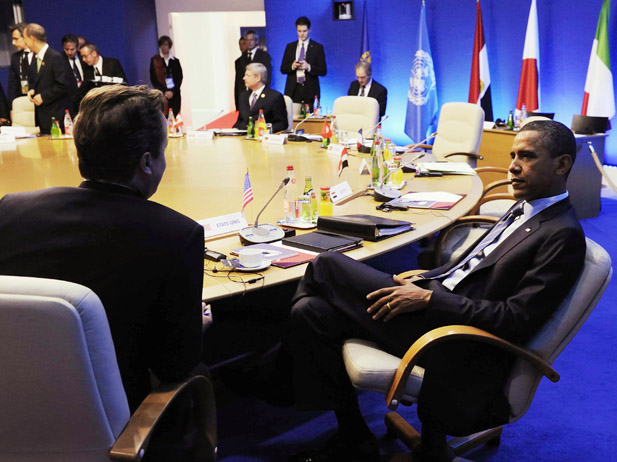
    The United States and other members of the Group of Eight (G-8) industrial nations (Germany, France, Canada, United States, Britain, Italy, Russia, and Japan) are attempting to assist Europe’s financial crisis. 

    President Barack Obama discussed the ramification during an upcoming meeting: “All of us are absolutely committed to making sure that the growth and stability and fiscal consolidation are part of the overall package.” However, many citizens from these European countries resist any financial solutions (i.e. austerity measures) that will take away their quality of life.

    At the same time of dealing with the global financial crisis, each country seeks to increase exports of goods and spearheading job creation in their own countries. Therefore, foreign government officials are in a risky situation by supporting any international agreed solutions which are very unpopular with their own citizens. 

    Since globalization has linked each country economically, Americans cannot escape either.  Regardless of the continent, people are looking for answers. Thus, countries must promote mutual financial interest internationally while keeping a pulse of their own self interest.   Therefore, countries with an isolationistic mindset will have a difficult time navigating in the future. 

    Please share your opinion on this topic. 

     © 2012 by Daryl D. Green                                    


  • Leaders Value Moms on Mother’s Day

    Here’s the reality.  Every great leader came from a woman.  Therefore, no one should  dismiss the influence of mothers on today’s leaders. With the media bombarding women with unrealistic expectations for mothers, it is any wonder that today’s mothers feel under huge pressures to be perfect.

    Stay-at-home mothers feel guilt for not providing financially as it takes two people to make ends meet. Working mothers feel the guilt of attempting to balance a career and a family at the same time. 

    Any person worth salt would recognize that mothers are often the glue that holds families together.  People don’t like other people talking poorly about their mother, even if she has many flaws.  In fact, no matter how unfit or imperfect your mother may be, she was still your mother.

    Your mother might have been a bad cook. She might have been a drug abuser. She might have been a terrible person. However, her imperfections are not open to public scrutiny. This article examines a 21st century motherhood model in contemporary society.  

    Good mothers are difficult to model. According to the US Census in 2008, there are over 82 million mothers in America. Many mothers go about their business with little regard for their impact on society. As a matter of fact, the value of a good mother is often forgotten, except for the customary card on Mother’s Day. Not all mothers are built the same when it comes to character.  

    Some women are openly unfit or unprepared to be mothers. The notion of an unfit mother is a legal definition which may vary from state to state. However, an unfit mother may be defined as a mother who fails to take care of the   basic needs related to the physical, mental, and spiritual state of a child. 

    For example, Susan Smith, who was from South Carolina, became the poster child for a bad mother. She had appeared on national television proclaiming that her two children had been kidnapped. In reality, Smith had driven her car into a lake, drowning her children. She had done this act in pursuit of her own adulterous relationship.

    Smith was later convicted in 1995 and sentenced to life in prison for murdering her two sons, Michael Daniel Smith, 3, and 14-month-old Alexander Tyler Smith. Many individuals would point to her as an abusive or neglecting mother. Furthermore, there are so many famous women who are esteemed as the modern day feminist model, but these women often do not represent the ideal mother figure. 

    Good mothers distinguish themselves with an unselfish behavior. They are the ones who go the extra mile so that everyone’s mental or physical condition is properly cared for.

    In fact, true mothers put their families’ needs ahead of their own. Of course, this selfless image runs counter to the “ME” only culture. King Lemuel must have realized this fact when he outlined his motherhood model in Proverbs 31. 

    The mother described in this passage is a loving wife, kindhearted mother, a champion of the oppressed, a business woman, a godly figure, and insightful advisor. The author notes about this woman, “Her children arise and call her blessed; her husband also, and he praises her.’” Therefore, character does count if an individual wants to use the right model for good motherhood. 

    Today, many people take a good mother model for granted. Some people complain about their mothers and how they do not fit today’s media model of an ideal mother figure. These unrealistic expectations cause some women to despair because they do not fit this unrealistic expectation. 

    When there is a mother of unique character in society, she should be celebrated and cherished. In the daily grind of living, many folks lose sight of the positive influence of the right kind of mother. A good mother creates a legacy for future generations. Let’s hope that the positive model will never be forgotten.

    Please share your opinion on this topic. 

    © 2012 by Daryl D. Green

  • Relationship Selling Toward Greater Profitability in the Future

    Is America in trouble?  On a daily basis we are being required to answer that question both subconsciously and openly by today’s media pundits.  Recent economic reports have shown vulnerabilities in the United States economic engine including everything from manufacturing to consumer spending. 

    Even the latest positive economic news brings another sequence of gloom. For example, the job rate ticked down in July, 2011; however, American businesses are not creating enough jobs. With unemployment still hovering over 9%, most people do not feel there  is much to be happy about related to the job outlook.    

    One of the smartest ways to retool the economy is by selling more products and services to domestic and international markets.  Therefore, the art of selling becomes a critical competitive advantage to organizations that want to sustain profitability over the long-term. Selling is a common denominator for every business. No matter what business you are in, you must sell your product or services to customers. 

    Yet, the concept of selling is related to creating value for customers.  When a bakery gives an extra donut in a dozen, the company is adding value and fosters better relationships with customers.  Given these realities, selling is a people-oriented business that addresses the customer value proposition. 

    Relationship skills can make or break important connections.  Dr. Dave Hinkes, co-author of Selling by Objectives: The Handbook for More Profitability in the 21st Century, often advises his Fortune 500 clients to stay connected with their customers.  Dr. Hinkes and I worked hard on this project.


    We further prescribe a relationship selling model based on several key elements which include branding, quality, flexibility, reliability, creativity, simplicity, efficiency, and price. Dr. Hinkes adds: “If you can practice or role play your responses to these objectives originating from any source, then you will find that you will be closing more deals, building more wealth, and saving time and effort in the process.” 

    For businesses, it is important to understand human behavior in order to building lasting relationships. Therefore, relationship selling and sales management are interconnected. Mark Johnston and Greg Marshall, authors of Relationship Selling, note the importance of these connections: “The managers in the sales organization have taken time to think through the most efficient and effective way to manage the customer side of the business”.  

    With competitors on each global corner, today’s businesses cannot afford to lose customers or markets.  Staying connected with customers is critical for sustainability.  Relationship selling is a good method for organizations to use.

    Like any relationship, there is a degree of tension involved in selling due to the need for solutions. The tension may be positive or negative depending on how much exists or how it is handled.  Businesses that can balance these conflicting interests will have an advantage over their competitors and an opportunity for greater profitability.

    Please discuss your professional experience with this topic. 

    © 2012 by Daryl D. Green


    [1] “Double-dip odds on the rise” by Scott Patterson

  • Guest Blogger – Burnout: An Unseen Blaze

    In this brief piece, I want to begin an exploration of burnout. Some believe burnout is self imposed by workers who can’t take the pressure. Others find that in the current economic and organizational climates, burnout is imposed by business that do not recognize or accept that workers need periods in their work days to decompress.  

    During the Vietnam era, American military members often recited a refrain for which I do not have a clear attribution; although one source attributes it to Mother Teresa.  

    “We, the unwilling, led by the unknowing, are doing the impossible for the ungrateful. We have done so much, for so long, with so little, we are now qualified to do anything with nothing.”  

    Many of the service members who recited this also suffered from the stresses of war, constantly being shelled by the enemy, constantly being on patrol in jungles where the enemy hid, constantly being exposed to team members injuries, wounds, and death.

    Movie watchers saw this portrayed with some degree of realism in Band of Brothers. These military men and women were constantly in a state of high arousal with few or no opportunities to decompress. 

    Is there a parallel to that refrain in the current economy, the current organizational climate? One source explains the parallel by citing that in the current climate (economic or organizational) there are often mismatches between job expectations and expectations of the person performing the job.

    Often, organizations place economic consequences ahead of human values. This confusion of values against economic needs of the employee to survive in an unstable work climate may result in lost productivity brought on by stress. 

    Question, who are the unwilling and why did they become unwilling? It their book, The Truth About Burnout, Maslach and Leiter found several reasons why people become unwilling. They find overwork and lack of control over their jobs as part of the problem.  

    Another question, who are the unknowing? The comic Dilbert provides an example of the unknowing in the depiction of the pointy-haired boss who reaps all the rewards for himself sharing none with workers.  

    Why has working become doing the impossible? Although the work may not be impossible to complete, workers feel a loss of community in the workplace. Political intrigue and rumors often force workers to withdraw from those around them.  

    An example of the ungrateful comes from the movie Office Space. The unit manager who strolled the isles of cube dwellers showed his lack of gratitude in his interpersonal interactions. Today, workers feel that they are not treated fairly and have to deal with values conflict.  

    Citing Maslach and Leiter again, they write, burnout is a result of “erosion in values, dignity, spirit, and will — an erosion of the human soul” (pg. 17). This is a strong provocative statement meaningfully explaining “doing so much, with so little, for so long.” The human spirit can become willing again if organizations take steps.  

    The modern military tries to relieve effects of stress and the resulting PTSD in the field and before and after a deployment. What are organizations doing to combat stress and burnout? The first step organizations must consider is the truth of burnout.

    Since the bottom line is the bottom line in contemporary business, one truth is that burnout takes an economic toll. Another truth is the emotional toll zapping the strength of workers both mentally and physically.  

    Organizations cannot afford to have unwilling and ungrateful elements if it wants to survive. Relieving the economic and emotional toll of burnout can take the “un” out leaving willing and grateful. People do not exist because of an organization; an organization exists because of people.

    Please comment on this topic from your personal or professional experience.

    About the Guest Blogger

    Dr. Paul Hoffman holds a Doctor of Strategic Leadership from Regent University, a Master of Arts in Leadership and Bachelor of Science in Organizational Communication from Bellevue University.

    Doctor Hoffman is an adjunct professor at Bellevue University and Metropolitan Community College in Communications Arts, English, and Communication and Humanities. Before his teaching role, Dr. Hoffman was a graduate enrollment counselor at Bellevue University and enrollment representative to the University’s Quality Council.  

    Dr. Hoffman came to the academic arena after ten years in retail management. During this period he managed in speciality mall stores, and multimillion dollar warehouse style stores. Dr. Hoffman owned a small business and was an insurance agent for a fraternal insurance provider.  

    Dr. Hoffman was a U.S. Air Force active duty noncommissioned officer retiring in 1990 as a Master Sergeant. During over 21 years of active duty, Dr. Hoffman was a Security Police sentry assigned to guard aircraft, missiles, and nuclear weapons on alert and in storage.

    For three years, he held the speciality of Military Training Instructor while supervising an installation correctional custody facility. In the concluding seven-plus years, Dr. Hoffman worked as an installation human relations and equal opportunity treatment NCO and finally as Superintendent of Social Actions overseeing both human relations and substance abuse prevention activities for an installation. 

    Military assignments saw Dr. Hoffman stationed at major Air Force Bases of the Strategic Air Command, U.S. Air Force Europe, and Pacific Air Force. During the Vietnam era, Dr. Hoffman had one assignment in support of major air operations over Vietnam. 

    Dr. Hoffman is married to Su Yun and they have two adult children. Son, Leslie Donald, is the oldest formerly a Captain in the U.S. Marine Corps. Les has two combat tours in Iraq.

    Daughter, Theresa Ann, was a member of the U.S. Peace Corps serving on the island of Carricaou, the Grenades; her Peace Corps specialty was Community Health focusing on AIDS awareness and prevention and presently studying to become a physical therapy assistant.

  • Nonprofit Sustainability

    Nonprofit organizations provide very valuable assistance to society. With shrinking funds for programs and a more competitive environment, nonprofit organizations will need to rethink their corporate strategies for future success.

    In 2005, there will be approximately 1.4 million nonprofit organizations registered to the IRS. The majority of nonprofits depend on volunteers at various levels. In fact, 74% of all public charities and 83% of all foundations are small; they have less than $500,000 in expenses and limited staff.  

    Negative market trends signal trouble for many nonprofit organizations. According to the Nonprofit Research Collaborative in 2011, 59% of nonprofits reported their donation income was flat or lower than 2010.  Although 41% of nonprofits saw an increase in their donations during this timeframe, smaller charities with less than $3 million in total spending saw donations drop. 

    In fact, food pantries and homeless shelters across the nation reported more usage which increased the cost of operations. Furthermore, 8% of charities noted they were in danger of closing according to the Center on Philanthropy at Indiana University.                                              

    Demanding contributors and the public in general are demanding more accountable and efficiency after several high profile scandals.  Nonprofit organizations are often influenced by their stakeholders that include clients, board of directors, committees, government officials, community leaders, staff, and volunteers.

    However, most nonprofit organizations haven’t completely embraced this rigor due to various reasons (i.e. limited resources and the lack of knowledge). Yet, nonprofit organizations have a greater need for increased effectiveness in their processes during this economic crisis.   

    Describe your professional experiences with nonprofit sustainability issues.

     © 2012 by Daryl D. Green                                                       


  • Disruptive Technology in Our Future


    In life, sometimes it is the simple things that count despite modern technology.  In the next few months, I will be able to see 3-4 of my books published.  Traditionally, it takes most large publishing houses 12-18 months before their books are published. 

    As an independent publisher, I learned that the speed of products to the market place is a good way to beat a large competitor.  In fact, my success relates to a simple website called Elance.com, a freelance website that allow customers to solicit work from a variety of outsourcing services which include programmers, designers, office support, translators, marketers, researchers and many other disciplines. 

    Elance.com allows a business to post a job opening and invites freelance workers who believe they have the requisite skills for the job to make a bid. The company charges a $10 fee to each business to post a job and also takes a small portion of what gets paid to contractors. 

     Through this website, I have found some of the most talented individuals from across the world. For these services, it is a buyer’s market.  Some people would argue that it is all about buying cheap labor for profitability.  

    In this scenario, developed countries appear to be exploiting underdeveloped countries.  This is not always true.  I have paid more in the past for the best talent.  With that said, potential employers see a website that attracts over 500,000 talented freelancers.  For the freelancer, there is an opportunity to bid on 48,000 jobs, worth $480K. Therefore, a differentiate strategy can defeat a low cost  strategy on a global playing field.  

    Technology must be a management tool that is used strategically.  Clayton Christensen, author of The Innovator’s Dilemma, provides a framework for understanding the interrelationship between technology changes and a business success. Christensen demonstrates how successful companies have been overtaken by small disruptive technologies. 

    The cell phone, undermining the profitability of the established communication networks such as AT&T, further showcases the impacts of disruptive technology.  Sadly, more executives are unwilling to think strategically due to the wrath of their investors and financial pundits.  

    For example, Amazon’s revenue grew in 2012 but the details were lacking.  Amazon.com’s revenue rose to 17.4 billion (35% increase) in the fourth quarter.  However, it fell short of Wall Street predictions. 

    According to VentureBeat, Amazon sold as many as 6 million Kindle Fires and its older tablet prototype . Given this reality, the Fire would move ahead of Android tablets from Sansung and Motorola, making it only second to Apple’s iPad. Analysts were concerned that the $199 Fire would make a profit.  Additionally, Amazon.com is spending capital on clouding technology.  

    Maximizing profits on Fire as an industry leading tablet is a near- term strategy. However, CEO Jeff Bezos appears to have disappointed Wall Street with a long-term perspective instead of sacrificing shareholders with profits in the near term. 

    Innovators take note of disruptive change as positive turbulence in the market.  John Gamble and Arthur Thompson, authors of Essentials of Strategic Management, explain, “Understanding the nature of competitively important resources allows managers to identify resources or capabilities that should be further developed to play an important role in the company’s future strategies.” Therefore, organizations which do not understand the importance of making sustainable growth by being more efficient will not be successful over the long-term. 

     Discuss your professional and personal experiences with disruptive technology.

    © 2012 by Daryl D. Green                                                       


  • Social Mobility in America

    Economic turbulence has overtaken the American way of life.  In Europe and Asia, investors stand uncertain of their next moves.  Even America is part of an economic casualty. 

    Yet, these problems are very personal to the average citizen. Higher gas prices and costs of living; the housing bust; and the financial crisis cause most people to worry about their future. With a weak job growth, many U.S. jobs continue to be shipped abroad. 

    Global competition continues to cause Fortune 500 companies to search for cheap labor to increase profitability.  This reality often places developed countries like the United States at a clear disadvantage.  Consequently, there has been an increasing gap between the wealthiest people and the poorest people in this country.  The reality has become the shrinking or disintegrating of the middle class.

    America is a shining symbol for social mobility across the world.  Social mobility can be defined as “the passage of individuals from one social class to another.” Most people feel that if they work hard, they can achieve a better life, regardless of their social standing. 

    In some countries, a person is stuck in an economic class with no hope of further advancement.  If your parents are uneducated and work a low paying occupation, the children will grow up in this same status.

    Marketing expert Michael Solomon argues the natural progression of social mobility: “People do improve their positions over time, but these increases are not usually dramatic to catapult them from one social class to another.”  The current economic picture makes social mobility more difficult.

    Michael Snyder, editor of theeconomiccollapseblog.com, argues the systematic destruction of the middle class: “The rich are getting richer and the poor are getting poorer at a staggering rate. Once upon a time, the United States had the largest and most prosperous middle class in the history of the world, but now that is changing at a blinding pace.” 

    Snyder supported his claims with 22 statistical facts.  Below is a sample of his analysis:

    • Eighty three percent of all U.S. stocks are in the hands of one percent of the people.
    • American workers now must compete against situations like China where a garment worker makes approximately 86 cents an hour and in Cambodia a garment worker makes approximately 22 cents an hour.
    •  Sixty one percent of Americans “always or usually” live paycheck to paycheck, which was up from 49% in 2008 and 43% in 2007.
    • Average Wall Street bonuses for 2009 were up 17% when compared with 2008.
    • More than 40% of Americans who actually are employed are now working in service jobs, which are often very low paying.
    • Sixty six percent of the income growth between 2001 and 2007 went to the top one percent of all Americans.
    • Only the top 5% of U.S. households have earned enough additional income to match the rise in housing costs since 1975.
    • In 1950, the ratio of the average executive’s paycheck to the average worker’s paycheck was about 30 to 1. Since the year 2000, that ratio has exploded to between 300-500 to 1.
    • As of 2007, the bottom 80% of American households held about 7% of the liquid financial assets.
    • The bottom 50% of income earners in the United States now collectively own less than 1% of the nation’s wealth.

    Many people hold that a political change will rescue the middle class.  As we have witnessed in the 2012 Presidential Election, petty politics are more important than solving the economic crisis.  Therefore, all families are held hostages. Any rescue will not be soon. 

    Snyder doubts there is any hopeful solution for the stale social mobility occurring today: “The reality is that no matter how smart, how strong, how educated or how hard working American workers are, they just cannot compete with people who are desperate to put in 10 to 12 hour days at less than a dollar an hour on the other side of the world.”  Many people hope that America can compete in the future without sacrificing her core values related to social mobility.  Others have given up this hope.

     Do you feel social mobility is unsustainable in the U.S. , given global competition?

     © 2012 by Daryl D. Green

  • Leading from a Public Platform

    I was in the process of getting another laptop since my last one was broken.  I decided to visit a local computer store to talk with its owner; I had been doing business with this company for over several years.  I was looking for an inexpensive laptop since I already had a desktop.  

    However, the owner suggested that he could build me a basic computer for a small price. I trusted and respected his opinion.  Yet, I went against the opinion leader because he didn’t fully understand my bottom-line.  Likewise, today’s opinion leaders who lose sight of their own constituents can lose their followers also.  

    For the record, an opinion leader is someone who is frequently able to influence others’ attitudes or behaviors. Michael Solomon, author of Consumer Behavior, suggests that opinion leaders tend to share consumer values and beliefs so that there is a connection between the opinion leader and the consumer.   

    Marketing expert Guy Bergstom further maintains that an opinion leader is anyone who has an active voice in a community. Therefore, these individuals often speak out on issues and get asked to provide advice.  

    In society, there are people who possess natural stature and credibility. Product developers use Hollywood celebrities because they are popular icons that allow them to be opinion leaders.

    Currently, the media heavily influences consumer behavior. The Washingtonpost.com has over 10,000,000 readers worldwide. Opinion leaders use this medium to influence public discussion while others come to learn more about the issues.  

    For example, most Americans feel negatively about outsourcing abroad, primarily to China and India. They view these foreign countries as a serious threat to American way of life. A recent Gallup-China Daily USA survey demonstrates how media can shift public opinion. Two-thirds of the public and a sample of United States opinion leaders view China to be a friendly ally of the United States.  

    With the assistant of the Internet, many individuals can influence other people like never before.  In fact, bloggers and website owners often upstage traditional media because these nontraditional sources because a frequent source for the average person.  However, it is important that opinion leaders never forget their followers in this social engagement.

    Discuss your professional and personal experiences with opinion leaders.


    © 2012 by Daryl D. Green