Being on vacation is a wonderful invention for humanity. Over the break from the daily grind, I went with my family to Navarre, Florida. It was quiet and surreal. I enjoyed walking the white sands in tranquility. Yet, the Gulf environment also provided contradictory outlooks.
Once the water was clear as a mirror, now it was clouded by dead seaweed on shore. One boy celebrated finding a dead fish washed to shore.
I wondered what impact the oil spill had on the pristine environment. The beaches showed evidence of commercialization as I saw trash (i.e. beer bottles, wrappers, etc.) abandoned on the beaches. It made me wonder if the ocean was dead.
Can anything be sustained over time? Leaders falter across the globe, from the biggest to the smallest countries. This month, world policy makers were unable to agree on fixes for their economy which sent investors on a wild ride for several weeks. Debts in Europe and the U.S. raise the question about the ability of political leaders to control ‘the trans-Atlanta panic.’ America’s on the blink?
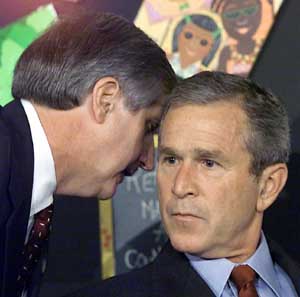
President Bush is notified of the September 11th Attacks.
In August, business empires were shaken. For example, two industry leaders (Microsoft and Wal-Mart) struggle to sustain growth. On August
12, 2011, the two companies were added to the Dow Jones U.S. Contrarian Opportunities Index, which tracks stocks that “lag behind the broader market in
terms of recent performance, but outrank their peers based on fundamental and other qualitative criteria.
Yet, American businesses outsource abroad in order to impress investors and shareholders. Corporate executives silently mock politicians, who desire them to pursue a business strategy of ‘creating jobs’ rather than an innate strategy of profitability.
U.S. political leaders, unable to break the ideology divide, lead financial investors on a wild goose chase with their indecision and create anxious and cynical citizens worried if they will be able to survive in the future.
Given these patterns of disruptive change, today’s institutions need strategic leaders with a clear view of sustaining success. Over the next several months, I will focus on strategic leadership and sustainability concepts in order to assist the next generation of leaders obtain the necessary attributes to overcome unknown circumstances.
Andres Edwards, author of The Sustainability Revolution, views sustainability consisting of key components, ecology/environment,
economy/employment, equity/equality, and education. He notes, “Success requires an understanding of the complex forces at work, a vision of the future and a strategy for making the vision a reality.
How are the concepts of traditional leadership at odds with the concept of sustainability as it relates ecology/environment, economy/employment, equity/equality, and education?
© 2011 by Daryl
D. Green
 Nu Leadership Revolution Blog