Has our society forgotten how to be appreciative? Many people are too busy running the rat race to say, “Thank you.” I remember sitting in a Sunday school class of young students during my college experience at Southern University. One student was saying how ungrateful he had been toward his parents. I also felt guilty. My parents bought me my first car while I was in high school; most students did not have cars. I had envisioned receiving a brand new car. Well, I did not.
I got an old 1973 Dodge Charger. I was disappointed. But, I ended up falling in love with that old car which I later called “The New Wave Cruisemobile.” My car was far more dependable than most automobiles. I remember never having said “Thank you” for my car – I had also taken my parents for granted. Our society does not teach us that being appreciative is a virtue. We will examines the importance of developing a spirit of gratitude as a competitive advantage toward employability. (more…)
When I was growing up, my mother was the youth director of our church. In elementary school, there are pressures about being cool. I was an active church member (and yes, a choir boy in the literal sense).
My mother expected her children to be the model young person, which involved participating in church required activities. For me, that meant participating in morning worship where the youth were required to lead devotion periodically. A call for volunteers would go out to the youth. Of course, most of my peers felt comfortable rejecting those requests to participate. (more…)
There is an increasing need for individuals to provide caregiving services. Social changes, such as financial crises, growing unemployment, job loss, homelessness, family break-ups, relationship issues, and other problematic concerns, place huge demands on government and community-based support services.
Pastor Richard S. Brown, a community advocate in Tennessee, talks about the pressing need of churches and other service organizations that are reaching out to the needs of people: “Everyone at one time or another will face giants in life. Giants represent those insurmountable problems, challenges, and obstacles in life.”
Often times, these giants of life cannot be solved without direct intervention from others. For example, the aging population is a growing problem for organizations providing caregiving services. According to the U.S. Census, 13% of the population is over 65 years old. The average life expectancy is 77 years. Women live longer than men. Seniors over 85 years old are the fastest growing segment of the population. Seventy five percent of people over 65 have one or more chronic health conditions.
Today’s organizations need to rethink the concept of caregiving in today’s society. First Lady Rosalynn Carter noted the importance of caregiving: “There are four kinds of people in this world: those who have been caregivers, those who are currently caregivers, those who will be caregivers, and those who will need caregivers.” A caregiver can be defined as ‘anyone who provides assistance to someone who is incapacitated and needs help.
Caregiving can be performed informally via unpaid (family members and friends) or formally (volunteer or paid caregivers associated with a service system). Currently, there are over 50 million caregivers. By 2020, caregivers will number 80 million. If one was to profile the typical caregiver, it would be described as the following: female (75%), over 50 years old (51%), sole provider (37%), and a relative (i.e. adult children- 57%).
Many organizations seek to address caregiving with generic solutions for their constituents instead of applying holistic approach to the specific person. The generic approach is faster and cheaper in many cases. However, Dr. Kenneth Haugh, author of Christian Caregiving: A Way of Life, argues the importance of understanding the needs of those individuals you are serving. Dr. Haugh observes, “Treating people as objects, as territory to be gained, is not only bad manners, but also completely fails to meet their unique needs and to respect their spiritual dignity before God.”
Organizations should value the welfare of the caregiver. Many people who provide care to others are overworked, stressed out, and on the verge of quitting. However, the organization that they are serving does not see this taking place. Some organizations treat their caregivers like objects. Caregivers suffer a variety of problems associated with caregiving.
In fact, caregivers have higher levels of stress, depression, fatigue, burnout, and lower levels of well-being and physical health. Furthermore, 49% of females and 31% of males experience depression as a result of caregiving.
High performing organizations understand that they must continuously re-assess their processes in order to sustain success. Yet, many nonprofit organizations and community-based organizations like churches that serve society forget about the mental and physical welfare of their caregivers in offering needed services to the area.
Here are some methods to use: (a) communicate the objectives of your organization and the desired outcomes, (b) train the caregivers so that they deal holistically with clients, (c) determine what the caregivers needs in order to perform an outstanding job and sustain this performance, (d) look for creative ways to prevent caregiver burnout and fatigue, and (f) provide an mechanism where caregivers and clients can provide feedback on continuous improvement in the caregiving area.
The pressures of life will continue to be problems for many people. Some individuals cannot overcome these giants in life without interventions. Caregivers play a critical role in assisting people in solving their problems. However, today’s organizations cannot continue to take caregivers for granted. Many caregivers are stressed out and underpaid; perhaps even on the verge of giving up their jobs in caregiving.
Therefore, this article maintains that today’s organizations must rethink their strategies for administering caregiving in the near future. Organizations that can make the necessary changes will be better prepared to sustain future success.
Ethical decision-making is important for businesses. Trust and integrity must not be lost. There are three ethical concerns for the sales organization, which are (1) cheating, (2) misuse of company resources, and (3) inappropriate relationships with other employees.
In fact, losing a customer or client’s trust is fatal stroke for businesses. Famous management expert Stephen Covey suggests that trust is the cornerstone for productivity in the market. Once customers lose faith and trust in an organization, that organization has lost ground in the market.
Employees are motivated by different stimulus. In fact, different employees have different motivations. Motivation produces psychological forces that determine the direction of a person’s behavior in an organization. In my technical field, there are few things that are impossible to accomplish; it’s a matter of time versus money.
However, finding these solutions depend on a personal drive. In many organizations, supervisors search for the magical ingredient to improve employee performance so that the organization can be successful. This initiative isn’t easy!
For example, a salesperson might be motivated to earn high commissions at any cost. He knows his management is only concerned with the bottom-line. At the end of the year, his sales manager responses in anger to this salesperson, “You’ve committed the company to something to which we cannot commit.” Therefore, being promoting selfish behavior can cost a business in the long run.
Organizations must train and create a good ethical environment. Gareth Jones and Jennifer George, authors of Contemporary Management, further argue effective managers fully utilize their human resources to gain a competitive advantage. Developing the desired behavior in employees is invaluable.
In many cases, employees exist in a transactional relationship (if you do this, you will get that). For example, a sales representative for Mary Kay will get a pink Cadillac if she reaches the designated sales limit. In fact, business perks are pretty routine.
Most people have an internal compass that allows them to distinguish right from wrong. For example, an employee might be tempted to take a bribe from his company’s competitor. Johnston and Marshall make a clear distinction between a gift and a bribe. A bribe is a financial present given to manipulate the purchase decision.
In an effective ethical system, an employee would not compromise the trust with the company, including any internal customers (supervisor, manufacturing group, etc.).
Finally, there will be numerous situations that test a person’s moral behavior in organizations. Ethical decision making is a way of life. Businesses must create good ethical systems where employees are accountable for their conduct. Trust must be at the center stage of the process.
Discuss your professional experience with making ethical decisions in your industry.
The WordPress.com stats helper monkeys prepared a 2013 annual report for this blog.
Here’s an excerpt:
The concert hall at the Sydney Opera House holds 2,700 people. This blog was viewed about 10,000 times in 2013. If it were a concert at Sydney Opera House, it would take about 4 sold-out performances for that many people to see it.
Several years ago, I was riding the Metro subway in Washington, DC and got off at the end of the line. The location was in a depressed area, and few businesses were there for commuters. As I waited for my ride, I saw these two boys carrying a huge box of M&Ms in hopes of selling to weary commuters.
I found it amusing that these young men were hustling in such a manner. Yet, this spoke to the spirit of entrepreneurs. The boys found an unmet need in the market. Yes, with no stores located in the immediate area, these young men sold a lot of M&Ms to hungry commuters.
With increasing competition abroad, today’s professionals cannot afford to be ignorant in understanding business practices such as marketing. The problem is that marketing is not second nature for all business professionals.
Sadly, most business owners do not have the time to take a long, drawn-out college course, while others want a simple process for understanding the basic concepts until they can take more formalized courses. In fact, when you do not have a lot of money to spend on advertising your product, you have to be smarter and more creative in order to stay ahead of the competition.
Marketing is the cornerstone of understanding today’s economic changes. Philip Kotler and Kevin Keller, authors of Marketing Management, argue the important of understanding marketing concepts for today’s professionals: “The first decade of the 21st century challenged firms to prosper financially and even survive in the face of an unforgiving economic environment. Marketing is playing a key role in addressing those challenges…Thus financial success often depends on marketing abilities.”
Consequently, marketing gives individuals the ability to understand how to locate these opportunities and what to do with them when you find them. According to the American Marketing Association, marketing can be defined as an organizational function and a set of processes for creating, capturing, communicating, and delivering value to customers. However, the simplest definition is that marketing is about understanding and satisfying customer wants or needs.
In fact, there are times when customers do not know what they want or desire. Marketing then becomes that linchpin in the process of finding a solution for the consumer. Traditionally, marketing has been defined in terms of four variables described as the marketing mix, or the 4 Ps: product/service, price, placement, and promotion.
In fact, the marketing mix is the controllable set of activities that entrepreneurs use to attract or respond to the needs of their target market. In essence, entrepreneurs attempt to create value for their customers. Value relates to the customer viewpoint, not that of the business. Value relates to the benefits the customer perceives they are getting in exchange for their purchase of the product or service.
Business experts Donald Lehmann and Russell Winer point out that inaccurate information or incorrect analysis often leads to poor decisions about marketing a business product. This flaw can hurt a business attempting to make a profit. In fact, understanding competition is a point most executives miss. Some of the questions executives should ponder include:
Who are my competitors?
What are the competing product features?
What is their positioning strategy?
What markets do they currently own and their future?
How do you distinguish your products from those of your competition?
How do consumers make this distinction in products?
In today’s global markets, organizations cannot operate with a ‘trial and error’ mentality. In fact, what worked yesterday is no guarantee that it will be successful in the future. Business professionals who are less knowledgeable about marketing and marketing forces are a liability to organizations that aim for sustainable success.
Successful entrepreneurs understand how to tap into their target market instead of random selling. Why should the expectations be any lower for today’s professionals? Therefore, savvy professionals seek to understand and implement effective marketing strategies.
Please discuss the value of understanding marketing concepts for professionals based on your own work experience.
Businesses attempt to persuade customers with their commercial messages. Consequently, they need to develop effective marketing communications. In a ‘marketing heaven,’ an organization would have the top brand in its category. In the real world, it is about a company showcasing itself in a good light with buyers.
Positioning involves a company putting its product or service in a favorable space in the minds of consumers. Therefore, positioning involves winning the customer’s perception over one’s competition. For example, McDonald’s uses its brand to position itself over the competition. When parents travel with their children, most children automatically want to eat at McDonalds.
If a company has an existing product and the overall consumer attitudes do not rank the product as highly as its competitors, the company has a chance to improve its positioning. The company needs to do a lot of research to see why it is viewed in this light before setting new strategies.
Michael Solomon, author of Consumer Behavior, maintains that the way a consumer evaluates and chooses a product varies widely, depending on such dimensions as the degree of novelty or risk in the decision. Additionally, the attitude of the organization has an impact on buyer behavior.
For example, a bad experience with McDonald’s can sway a parent from going to McDonald’s; they may seek an alternative. In fact, Mark Johnston and Greg Marshall, authors of Relationship Selling, further argue that customers pick up on a salesperson’s attitude. Does good chemistry exist between the salesperson and the customer? That’s an important performance measure.
When developing performance measurement with relationship selling in mind, good chemistry between the salesperson and customer should be a factor. Likewise, improved company attitudes can have a positive impact on customer behavior.
Please discuss the value of effective marketing communications to customers.
Everywhere you turn life has become complicated. With a cell phone in my pocket, people can reach me in remote places or traced me down with a GPS device. Ironically, that cell phone that helps me is also said to be possibly killing me at the same time. Yet, life was much simpler.
Before the Industrial Revolution, life was centered on land and labor. On this land, God gave man his divine “agrarian calling.” Humanity was technology poor yet spiritually rich in the Agrarian Era. In the same framework, one can analyze the moral compass of society through the ages.
Agrarians had a love for community and order; a deep respect for the environment; and a genuine peace with their Creator. Family was first! Agrarians were independent decision-makers. However, Agrarians went away from the land with every economic advancement.
From the steam engine to the Internet to nanotechnology, humanity has transitioned from the physical labor of the land to mental brain power away from the land. Andres Edwards, author of The Sustainability Revolution, echoes the advancement of this period: “These inventions contributed to increase production and economic growth in the textile, iron, rail and steamship industries that have left an indelible mark on our current society.”
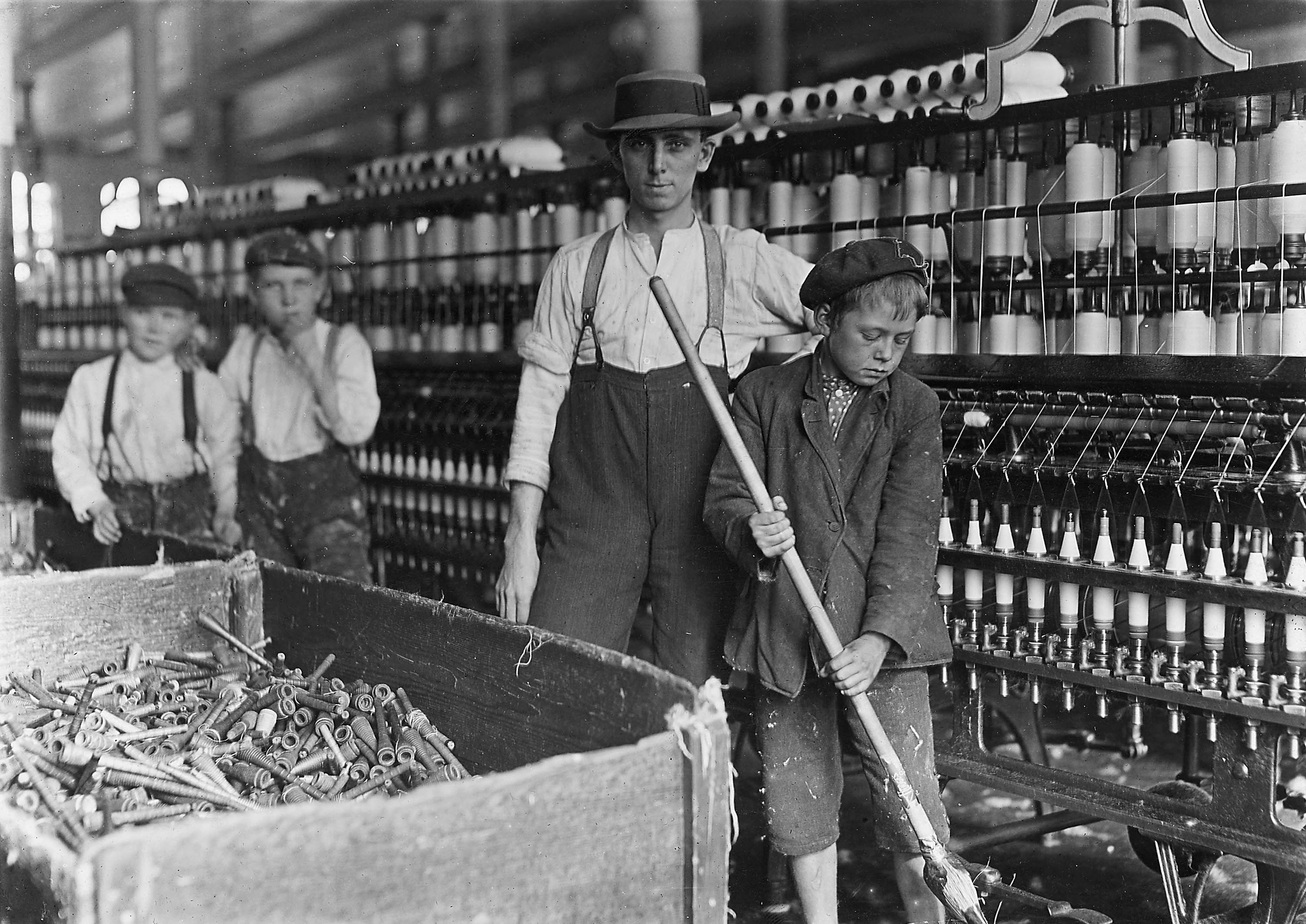
Yet, the effects were not all positive. Farmers went from freedom in the land to industrial slaves. During this transition, managers controlled the factory workers. These forced interactions created conflict because farmers and industrial society had different value systems.
Each successive wave of technology brought with it giant leaps in productivity while expanding the moral decay of mankind. In fact, the Industrial Era ushered in a period of materialism, competitiveness, self-sufficiency, and the supremacy of man. With each technological advance, social consequences also swept across the world like a tidal wave.
Are the principles of the Agrarians lost? If not, why?
Any student can tell you I set high expectations for them, regardless of their backgrounds and college classifications. Yet, any time you ask some people to go beyond their comfort zone and stretch themselves a bit mentally, a professor is going to get some backlash.
Nevertheless, I designed a new final project called Real World Application based on one of the top tiered business schools. The objective was to provide students in my Operations Management course some practical applications from the course and assist local organizations with their problems. This is when I fully understood the challenges that many nonprofit organizations faced in this economic climate.
Most students selected private businesses while a few opted for nonprofit organizations. Noriko Chapman, the past guest blogger, got me involved more with her project since she complained she needed to do well in my course. Her project entailed assisting the Tennessee Vocational Rehabilitation Center (TRC’s), located in Maryville, to be more efficient and effective. TRC’s mission is to provide services that help lead individuals who have a physical and/or mental disability to employment and are designed to meet individual needs.
Her employer, DENSO, had been working to assist this nonprofit organization with a contract that allowed disabled workers to earn income. Her research helped TRC become more efficient. Noriko’s final project was the main inspiration for her new book, Second Chance: An In-depth Case Study on Nonprofit Organization’s Resource Allocation and Operational Maximization.
During the economic crisis this year, the organization nearly lost $72K from government funding. It was clear to me that nonprofits needed to get their act together and create more value to the sponsors and customers or face extinction.
With shrinking funds for programs and a more competitive environment, nonprofit organizations will need to rethink their corporate strategies for future success. In 2005, there will be approximately 1.4 million nonprofit organizations registered to the IRS.
The majority of nonprofits depend on volunteers at various levels. In fact, 74% of all public charities and 83% of all foundations are small; they have less than $500,000 in expenses and limited staff.
Nonprofit organizations are different from traditional organizations and require special considerations in their operations. Operations management (OM) has been a vital instrument in the pursuit of greater productivity in the business sector.
OM includes planning, coordinating, and executing all activities that create goods and services. Robert Jacobs, Richard Chase, and Nicholas Aquilano, authors of Operations & Supply Management, suggest that implementing OM assists organizations to be more competitive: “Compared with most of the other ways managers try to stimulate growth – technology investments, acquisitions, and major market campaigns, for example – innovations in operations are relatively reliable and low cost.” Today’s businesses have built elaborate systems for better efficiency and effectiveness. Yet, most nonprofits are forced to rely upon low-end technologies and outdated practices.
Demanding contributors and the public in general are demanding more accountable and efficiency after several high profile scandals. Nonprofit organizations are often influenced by their stakeholders that include clients, board of directors, committees, government officials, community leaders, staff, and volunteers.
However, most nonprofit organizations haven’t completely embraced this rigor due to various reasons (i.e. limited resources and the lack of knowledge). Yet, nonprofit organizations have a greater need for increased effectiveness in their processes during this economic crisis.
Describe your professional experiences with nonprofit sustainability issues.
Americans are increasingly worried and cynical of today’s leaders. Traditional institutions are losing favor, leaving citizens unable to trust their neighbors, churches, and government.
Additionally, America has a history of unethical behavior by leaders. The private sector has been riddled with tons of examples (i.e. Enron, Exxon, etc.) of unethical behavior on Wall Street. Furthermore, political parties market family values and personal integrity like they are selling used automobiles.
In the quest for power and their own personal ambition, many government officials have been drawn to deadly vices that have led to their personal self-destruction. Graham Tomblin, The Seven Deadly Sins, notes this natural selfish behavior has destroyed families, friendships, happiness, and peace of mind.
These moral break downs can seep into other factions of the political landscape. For example, in 1998, the media reported the sexual exploits of Democratic President Bill Clinton with Monica Lewinsky. However, political scandals are nothing new for the federal government. During the months of May to August of 2007, Republican President Ronald Reagan’s administration was suspected of trading weapons for hostages in the Iran-Contra hearings.
This topic explores the American political environment and how amoral behavior associated with ‘seven-deadly sins’ impact contemporary organizational culture. For this discussion, we evaluate Congressman Mark Foley’s scandal. Foley was a Florida congressman, who was reported to have sent sexually explicit emails to male pages who were high school students.
He abruptly resigned on September 29, 2006, which set-off a political landmine. House Republicans had to do damage control, whileDemocrats went on the attack. Some Democrats claimed that some House leaders knew for months of Foley’s inappropriate behavior. House SpeakerDennis Hastert found himself on the political hot seat. Hastert declared he knew nothing about Foley’s actions, but others disagreed with his proclamation. Hastert continued his claim of innocence as he asked the JusticeDepartment to investigate this matter.
Because of Foley’s resignation, he couldn’t be punished by his peers. Foley also apologized publicly, sought treatment for his alcoholic addicted, and pointed to a childhood abuse experience by a priest as a cause of his problem. Once again, Americans were asked to address another ethical issue among government officials.
In many cases, unethical decisions made by individuals who allow their ethical principles to influence their decision-making, led to laws being broken or the compromise of organizational values. Moral principles, values, or beliefs about what is “right” or “wrong” are known as ethics.
Consequently, individuals who make decisions outside of the organization’s values sustain their moral principles internally. Ethics and organizational culture can impact the success of an organization. In fact, ethical behavior is directly related to culture.
In the long-term, unethical behavior impacts an organizations ability to function effectively. Employees watch what leaders do more than what they say. Therefore, organizations that want to sustain future success must pay attention to their ethical behavior, at all levels.
Describe your professional experiences with ethical behavior by executives as well as others in the organization. Discuss what can be done to instill good ethical behavior throughout the organization