Globalization’s Unintended Consequences for Americans

global-sourcing-man-strategy

Even in fun, you should see the obvious.  Last fall, my wife and I went on a cruise to the Caribbean.  During this seven day adventure, we visited several countries that catered to our whims as Americans. 

Yet, the impacts of globalization were obvious on the cruise ship.  Both the passengers and the cruise staff appeared to operate within their own cultural preferences when not having to succumb to the dominant culture.  

There were several occasions where there was multiple languages being spoken in the same area which provided a different backdrop to me as an American.  We were all interconnected but yet apart. 

Global forces continue to change business operations and society as a whole.  The results of globalization mean that countries, businesses, and people become interdependent.  Organizations typically pass through four stages to international commerce: The domestic stage, the international stage, the multi-national stage, and the global stage. In search of more profitability, companies send many of their business functions abroad in an attempt to obtain cheaper resources (i.e. labor) for products or services.  

Should globalization change our thinking as Americans too? In the 1960s, the United States was a megastar internationally, accounting for 66.3% of worldwide foreign direct investments. As globalization began to open barriers to the free flow of commerce, non-U.S. firms sought to increase production activities to establish a presence in major foreign markets.  

Given these changes, things started happening.  In 2009, non-U.S. firms accounted for 14.1% of the stock foreign investments with the majority of these firms based in Hong Kong, South Korea, Singapore, Taiwan, India, and China.  Charles Hill, author of International Business, notes:  “The world may be moving toward a more global economic system, but globalization is not inevitable. Countries may pull back from their recent commitment to liberal economic ideology if their experiences do not match their expectations.”


Of course, globalization is not all good. America was once the center of all important business transactions internationally.  However, now there is an emergence of other key global partners.  Brazil, Russia, India, and China are becoming dominate providers of products and services abroad. 

With the threat of outsourcings, many Americans are worried about job opportunities.   Richard Daft, author of Management, further argued about the impacts of globalization: “For today’s managers, the whole world is a source of business threats and opportunities.” Should U.S. parents worry about their children’s future given the declining role of the United States in the global environment? 

Today’s American students are not doing better than their parents as it relates to education.  According to the Organization for Economic Cooperation and Development (OECD), the U.S. ranks fourth worst among 29 developed countries for children obtaining a higher level of education than their parents.  

Only 21.6% of those 25 to 34 years old achieved a higher level of education than their parents in the United States. That compares to an OECD average of 36.8%.  Consequently, current and future U.S. workers will be vulnerable to the consequences of globalization.  Unfortunately, many politicians, executives, and media pundits do not have a long-term perspective about the opportunities and threats related to globalization.  They should! 

Discuss the opportunities and threats associated with globalizations and how emerging leaders can compete.

© 2013 by Daryl D. Green

New Value Creation Model

value-smart-shopping

I received an email from Dr. Marcus Blakemore about a very fascinating website called Fiverr.com. At first, I was very skeptical because freelancers like technical writers and web designers were offering their services for $5. In fact, these services were listed well below market prices.

Yet, the site also offers bizarre services like someone writing something on his or her lips to a person dressed in a clown suit willing to send greetings to anyone. Loaded with my conventional wisdom of ‘you get what you pay for,’ I gave the website a chance. Through this effort, I found some vendors were outstanding while others were mediocre.

Amazingly, the owners of Fiverr.com had created a niche for themselves with freelance websites, such as Elance.com or Guru.com. However, a new value proposition was also developed.

For experienced sellers, Fiverr.com provides a promotional venue where they can sell more expensive services down the product line, newbie sellers can turn their hobbies into financial gains, and value-seeking buyers can secure some quality services well below market value.

With the pressures of globalization all around, organizations are finding that creating value becomes a necessity. This article examines the concepts of value creation in today’s competitive environment. 

Twenty-first-century organizations can no longer implement value creation in a vacuum. Ken Favaro, author of Put Value Creation First, further suggests that placing a priority on value creation gives businesses two advantages over their competition: The first is capital and the second is talent. Favaro argues that successful value creators never suffer from capital shortage.  

Value focuses on the relationship between the customer’s expectations of a product or service and the amount paid for it. C.K. Prahalad and Vemkatram Ramaswamy, authors of The Future of Competition, further reasoned that twenty-first-century corporations must adapt their value creation system to fit the global scale.

They noted the new system is an individual-centered, co-creation of worth between consumers and organizations.  Few executives take the time to explain their values, but this will be increasingly important if companies hope to expand success in their global market. 

For many people, the concept of value creation is vague. An exact definition of value depends on the individual, but it could be defined as the net bundle of benefits the customer derives from a product or service.

According to Businessdictionary.com, value creation denotes ‘the performance of actions that increase the worth of goods, service or even a business.’  Consequently, value creation for customers encompasses developing products and services that customers find consistently useful.  

Mark Johnston and Greg Marshall, authors of Relationship Selling, argue that an individual must understand the customer to establish value.  Furthermore, Paul Peter and James Donnelly, authors of Marketing Management, argue that the starting point in the buying process is the consumer’s recognition of an unsatisfied need. The customer must remain the focus for any sustainable business success. 

Value creation must also be a strategic and deliberate concept for professionals. Mark Johnston and Greg Marshall maintain that perceived value is in the eyes of the customer. Therefore, perceived value will vary. A professional’s biggest challenge is in selling this value with consistency. Being strategic about these business relationships is not simple. Organizations must clearly understand the external motivation within their market in order to create lasting customer value. The external environment is considered anything outside of the organization’s control. External environment factors include economic stability, legal-political shifts, technological growth, social-cultural norms, and natural changes.

With businesses losing market sharing to companies abroad, organizations must establish clear value propositions to their customers. Paul O’ Malley, the principal of Paul O’Malley Associates (Newton, MA), argues the crucial need of value creation for companies: “The most successful organizations understand that the purpose of any business is to create value for customers, employees, and investors, and that the interests of these three groups are inextricably linked. Therefore, sustainable value cannot be created for one group unless it is created for all of them.”

Furthermore, today’s professionals always need to provide value for their employers and customers. In tough times, organizations want to keep their best people. In order to sustain lasting success, value creation must be an important ingredient of corporate business strategies during economic turbulence.

Describe an opportunity or problem in an industry where a new product or service would be benefical to customers because it would provide new value for them.

© 2013 by Daryl D. Green

Emerging Markets

I remember listening to Kenny Rogers sing “The Gambler” growing up in my community.  As many of you know, Rogers is a country artist.  I was well aware that if my friends knew I listened to country music, I would have lost my ‘cool card’ among my rapped-crazed peers.  Today, the lyrics of “The Gambler” still guide my business strategy. 

“You got to know when to hold ’em, know when to fold ’em
Know when to walk away and know when to run
You never count your money when you’re sittin’ at the table
There’ll be time enough for countin’ when the dealing’s done
Every gambler knows that the secret to survivin’
Is knowin’ what to throw away and knowing what to keep” 
 

If most senior leaders would guide themselves with this simple lyric, their organizations would be better off.  For example, you find a good spot in the lake where there are an abundance of fish.  You keep this secret, but then start sharing it with a few friends. Sadly, the word gets out about your special spot.  

Finally, you find yourself squeezed out from your favorite spot.  It’s a hot spot now.  The fish are being topped out.  Yet, people continue to fish there despite obtaining less fish and requiring more time to get the same results.  Even though you love the spot and have a sentimental connection with this area, you abandon this location and move to another unknown location that shows plenty of potential.  You moved not because you wanted to move; you moved because you are a fisherman who loves catching fish. 

Likewise, today’s businesses are operating abroad in order to catch more fish and obtain more profitability.  U.S. multinational companies, like Coke Cola and McDonalds, realize that America’s market is pretty saturated and riddled with hypercompetitions.  

How many more burgers or cokes can Americans continue to consume?  Additionally, companies hope to lower their costs by searching for a lower cost labor force.  Charles Hill, author of International Business, suggests that outsourcing is systematic:  “By doing this, companies hope to lower their overall cost structure or improve the quality or functionality of their product offering, thereby allowing them to compete more effectively.”[1] Therefore, emerging markets become more attractive. 

The fragility of today’s world’s economies demands that businesses act more prudently and decisively about their market strategies. Emerging markets, which were once stigmatized with the name ‘Third World’ markets, will be a dominate player in the world’s future economy.


The top four emerging markets include China, Brazil, India, and Russia.  According to Goldman Sach’s projects, these countries will overtake the seven largest industrialized countries (United States, Japan, Germany, France, UK, Italy, and Canada) by 2040.  Antoine va Agtmael, author of The Emerging Markets Century, argues that the prominent role of emerging markets is in future commerce.   

He predicts revolutionary changes due to these emerging markets and equates these changes to the second industrial revolution.  Some of the key success factors for these emerging companies are the following: (1) an obsessive focus on quality and design, (2) brand building, (3) logistics, (4) being ahead of competitors in adapting to changing market trends, (5) acquisition savvy, (6) sustaining an edge on competition in information technology, (7) clever niche strategies, and (8) unconventional thinking.[2]  

Additionally, these companies have a hunger to compete since their success will improve their way of life. Sadly, many Americans do not understand the level of poverty that motivates these countries. Agtmael further notes: “A new breed of companies will play a critical role in producing this shift; a select number of which truly deserve to be regarded as world class. 

In the face of these firms’ vigorous emergence on the world stage, there will be a temptation to go into protective mode….”[3]  However, globalization makes retreating a passive signal of being defeated in a world market.  Therefore, U.S. companies like IBM and Google may see themselves fighting to keep their dominance from unrecognized firms from these emerging countries with a hunger to topple established U.S. businesses. 

Discuss how U.S. companies can effectively address the competition from firms located in emerging markets. 

© 2012 by Daryl D. Green


[1] International Business by Charles Hills

[2]The Emerging Markets by Antoine va Agtmael

[3]The Emerging Markets by Antoine va Agtmael

Bubble Watching

I knew something bad would eventually happen.  As a young boy in Shreveport, we would regularly ignite fireworks without adult supervision. Often these fireworks were loaded as if we were going to war. Being boys with unlimited courage (or foolishness), we would deviate from the prescribed manufacturer’s guidelines (there were none). 

Typically, we would get the most potent firecracker a/k/a Black Cats.  We would light the firecracker and release it at the last minute.  Of course, someone would attempt to be most courageous and wait even longer.  Yes, you may guess it.  Someone would eventually get hurt. However, we dared not to let an adult know.  

Likewise, our financial situation is in a crisis across the globe.  Yet, most business institutions continue to act in an unwise behavior which eventually will get them into trouble, a/k/a a bubble burst.   

A bubble can be defined as “whenever an asset’s perceived or psychological value exceeds its real economic value.”  It’s not rocket science in understanding bubbles. For example, people purchased overpriced homes that they could not continue to pay for.  The housing market’s bubble burst.  Millions of dollars came tumbling down with this bubble.  Therefore, bubbles can be toxic.    

Some bubbles are easier to see than others.  For example, Europe may be looking at a very rocky financial future.  In its book Beyond Austerity: A Path to Economic Growth and Renewal in Europe, the McKinsey Global Institute outlines the trouble that Europe faces: “The challenges Europe faces are serious-more so for some economies than others.”  

Europe’s political will is unable to change its social model.[1]  In 2009, EU-15’s productivity rates were 15% lower than the United States. In fact, Europeans work, on average, 5 weeks less than workers in the U.S. (U.S. workers are among the best in the world in productivity).  

Their seasoned citizens (ages 55-64 –years old) do not actively participate in work activities compared with the senior population in America. Many of their social services are provided by the government which puts a heavier burden on resources. Europeans are reluctant to change their current social model that is driving them into an economic ditch.  Consequently, a bubble will eventually burst. 

However, America cannot believe it’s immune to a bubble crisis like Europe.  John Wiedemer, Robert Wiedemer, and Cindy Spitzer, authors of America’s Bubble Economy, correctly predicted the 2008 economic crisis several years before it happened. 


Additionally, they predicted that America is headed for an even worse economic crisis, regardless of the political parties in charge.  They understand the power of understanding bubble trends:  “…the bursting of America’s bubble economy will create a temporary Bubblequake of shockwaves here and around the world, depressing stock and real estate values, driving up interest and inflation, and throwing the U.S. and other economies into temporary global recessions.”[2]  The following elements are what the authors saw as bubble busters for the American economy before the 2008 bubble burst:

  • Huge international trade deficits that just keep getting bigger.
  • An astronomical $8 trillion federal government debt, heavily financed by foreign capital.
  • Ever-expanding consumer debt with no equal rise in consumer income.
  • The lowest savings rates in America’s history.
  • A national housing market that has climbed 80% in the last several years while income rose only 2%.
  • An economy that is now heavily dependent on historically low interest rates and low inflation rates that require massive foreign capital to maintain.

 Clearly, those predictions were made for 2008.  However, has anything changed since then as it relates to these elements?  Consequently, those organizations that watch bubbling trends, analyze them, and act accordingly have the greatest opportunities for sustainable success. 

Discuss a potential bubble in your industry and how an organization or individual can leverage this problem into an opportunity? 

© 2012 by Daryl D. Green


[1] Beyond Austerity: A Path to Economic Growth and Renewal in Europe by the McKinsey Global Institute

[2] America’s Bubble Economy by John Wiedemer, Robert Wiedemer, and Cindy Spitzer

Stopping the Global Crisis

Last week, I received news that I was going global.  It was exciting news. Aren’t we interconnected anyway?  My primary publisher, Createspace, announced that my books would now be available directly through Amazon’s European websites, including Amazon.co.uk, Amazon.de, Amazon.fr, Amazon.es, and Amazon.it.

As the world’s largest online retailer, Amazon.com is the parent company of Createspace Publisher.  Globalization has connected our lives together.  If organizations are going to be successful in the future, they need to be strategic. Finding talent and solutions will be vital, regardless of the continent.  

Globalization prevents us from hiding out in our countries. With the issues of austerity in Europe and threats in Iran, organizations are struggling to stay ahead of all the significant changes.  Global turbulence continues to haunt financial institutions.

Most economic experts believe that Europe is in recession. According to Britain’s Office for National Statistics, the first quarter of this year Britain’s economy shrank .2%, after having contracted .3% in the fourth quarter of 2011. Europe struggles to maintain financial stability while country after country falters.  Greece, Spain, Portugal, and Italy lead the list of financially crippled countries in Europe.  

Around the world, countries continue to suffer from unprecedented changes. The year 2011 was a vintage time for massive protests, from the awakening of the Arab world to the defeat of evil tyrants. Japan suffered its biggest nuclear catastrophe. 

Egypt is now crippled by economic turmoil, inadequate health care, and continued unrest in the country.  In fact, the country is headed toward another milestone as Egyptians decide who will be their president and architect for leading them into the future.  

Voters may elect to move toward an established Islamic nation; this fact is driven by religious clerics and other influential parties who desire a more religious country. 

Shady Ghoneim, an Egyptian importer, worries about the country’s political fate internationally: “Foreign investors won’t come back unless they can trust a moderate president.”  Troubles in one country can have a negative impact to other nations due to these financial linkages. 

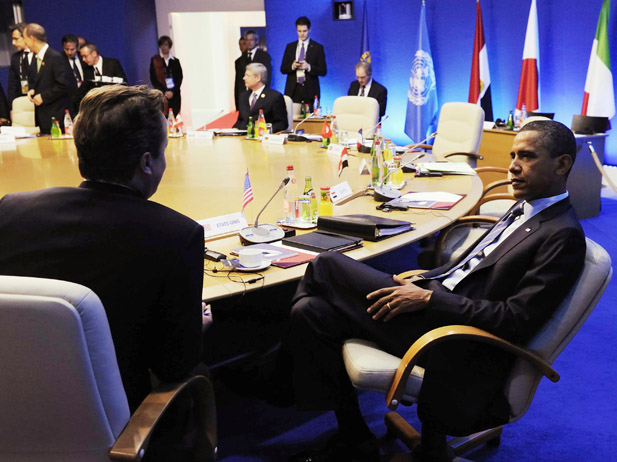
The United States and other members of the Group of Eight (G-8) industrial nations (Germany, France, Canada, United States, Britain, Italy, Russia, and Japan) are attempting to assist Europe’s financial crisis. 

President Barack Obama discussed the ramification during an upcoming meeting: “All of us are absolutely committed to making sure that the growth and stability and fiscal consolidation are part of the overall package.” However, many citizens from these European countries resist any financial solutions (i.e. austerity measures) that will take away their quality of life.

At the same time of dealing with the global financial crisis, each country seeks to increase exports of goods and spearheading job creation in their own countries. Therefore, foreign government officials are in a risky situation by supporting any international agreed solutions which are very unpopular with their own citizens. 

Since globalization has linked each country economically, Americans cannot escape either.  Regardless of the continent, people are looking for answers. Thus, countries must promote mutual financial interest internationally while keeping a pulse of their own self interest.   Therefore, countries with an isolationistic mindset will have a difficult time navigating in the future. 

Please share your opinion on this topic. 

 © 2012 by Daryl D. Green                                    


Disruptive Technology in Our Future


In life, sometimes it is the simple things that count despite modern technology.  In the next few months, I will be able to see 3-4 of my books published.  Traditionally, it takes most large publishing houses 12-18 months before their books are published. 

As an independent publisher, I learned that the speed of products to the market place is a good way to beat a large competitor.  In fact, my success relates to a simple website called Elance.com, a freelance website that allow customers to solicit work from a variety of outsourcing services which include programmers, designers, office support, translators, marketers, researchers and many other disciplines. 

Elance.com allows a business to post a job opening and invites freelance workers who believe they have the requisite skills for the job to make a bid. The company charges a $10 fee to each business to post a job and also takes a small portion of what gets paid to contractors. 

 Through this website, I have found some of the most talented individuals from across the world. For these services, it is a buyer’s market.  Some people would argue that it is all about buying cheap labor for profitability.  

In this scenario, developed countries appear to be exploiting underdeveloped countries.  This is not always true.  I have paid more in the past for the best talent.  With that said, potential employers see a website that attracts over 500,000 talented freelancers.  For the freelancer, there is an opportunity to bid on 48,000 jobs, worth $480K. Therefore, a differentiate strategy can defeat a low cost  strategy on a global playing field.  

Technology must be a management tool that is used strategically.  Clayton Christensen, author of The Innovator’s Dilemma, provides a framework for understanding the interrelationship between technology changes and a business success. Christensen demonstrates how successful companies have been overtaken by small disruptive technologies. 

The cell phone, undermining the profitability of the established communication networks such as AT&T, further showcases the impacts of disruptive technology.  Sadly, more executives are unwilling to think strategically due to the wrath of their investors and financial pundits.  

For example, Amazon’s revenue grew in 2012 but the details were lacking.  Amazon.com’s revenue rose to 17.4 billion (35% increase) in the fourth quarter.  However, it fell short of Wall Street predictions. 

According to VentureBeat, Amazon sold as many as 6 million Kindle Fires and its older tablet prototype . Given this reality, the Fire would move ahead of Android tablets from Sansung and Motorola, making it only second to Apple’s iPad. Analysts were concerned that the $199 Fire would make a profit.  Additionally, Amazon.com is spending capital on clouding technology.  

Maximizing profits on Fire as an industry leading tablet is a near- term strategy. However, CEO Jeff Bezos appears to have disappointed Wall Street with a long-term perspective instead of sacrificing shareholders with profits in the near term. 

Innovators take note of disruptive change as positive turbulence in the market.  John Gamble and Arthur Thompson, authors of Essentials of Strategic Management, explain, “Understanding the nature of competitively important resources allows managers to identify resources or capabilities that should be further developed to play an important role in the company’s future strategies.” Therefore, organizations which do not understand the importance of making sustainable growth by being more efficient will not be successful over the long-term. 

 Discuss your professional and personal experiences with disruptive technology.

© 2012 by Daryl D. Green                                                       


Guest Blogger – Serendipity


Horace Walpole coined the word serendipity in 1754 after reading the Three Princes of Serendip. The princes “were always making discoveries, by accident and sagacity, of things they were not in quest of.” Today, we have tools at our disposal that allow us to manage serendipity or, at least, place ourselves strategically so that serendipity is possible.


What is serendipity? The traditionally accepted definition of serendipity is “the occurrence and development of events by chance in a happy or beneficial way.” Well then, if events are by chance, how is it possible to place ourselves in a position in which serendipity is likely?


In their book, The Power of Pull: How Small Moves, Smartly Made, Can Set Big Things in Motion, Hagel, Brown, and Davison relate the value of social networking. They specifically mention Facebook, LinkedIn, and Twitter as points of connection to friends and friends of friends. Through these connections we discover others’ have and can share tacit knowledge that we may benefit from.

Through the same connection, others can grow from connecting with us gaining our tacit knowledge. It not a contest to see how many friends we have in our network, rather it is about how we manage our network of friends.


Imagine a chance reading of friends’ Facebook wall posts that result in an opportunity to connect with another with whom we share an interest. In this situation, we’ve experienced a “chance event in a happy and beneficial way.” What is the likelihood of this event happening had we not had a Facebook profile, not been linked to our friend, and not been able to read that wall post?


Serendipity allows chance meetings for planting seeds of learning and growing if we manage opportunities for chance meetings. Wisdom of the East tells the story of a man, “I have nothing to teach and so much to learn.” In reply, “Oh dear! Haven’t we all something to teach and something to learn?”


We are not Princes of Serendip making discoveries by accident. We can create opportunities for serendipitous events to evolve. Do not wait for opportunities to come, seek them, manage them, and benefit from them. Grow in learning; grow in teaching.

Please share your comments on this topic.  

ABOUT THE BLOGGER


Dr. Paul Hoffman holds a Doctor of Strategic Leadership from Regent University, a Master of Arts in Leadership and Bachelor of Science in Organizational Communication from Bellevue University. Doctor Hoffman is an adjunct professor at Bellevue University and Metropolitan Community College in Communications Arts, English, and Communication and Humanities.

Before his teaching role, Dr. Hoffman was a graduate enrollment counselor at Bellevue University and enrollment representative to the University’s Quality Council. Dr. Hoffman came to the academic arena after ten years in retail management. During this period he managed in speciality mall stores, and multimillion dollar warehouse style stores. Dr. Hoffman owned a small business and was an insurance agent for a fraternal insurance provider.


Dr. Hoffman was a U.S. Air Force active duty noncommissioned officer retiring in 1990 as a Master Sergeant. During over 21 years of active duty, Dr. Hoffman was a Security Police sentry assigned to guard aircraft, missiles, and nuclear weapons on alert and in storage. For three years he held the speciality of Military Training Instructor while supervising an installation correctional custody facility. In the concluding seven-plus years, Dr. Hoffman worked as an installation human relations and equal opportunity treatment NCO and finally as Superintendent of Social Actions overseeing both human relations and substance abuse prevention activities for an installation.


Military assignments saw Dr. Hoffman stationed at major Air Force Bases of the Strategic Air Command, U.S. Air Force Europe, and Pacific Air Force. During the Vietnam era, Dr. Hoffman had one assignment in support of major air operations over Vietnam. Dr. Hoffman is married to Su Yun and they have two adult children. Son, Leslie Donald, is the oldest formerly a Captain in the U.S. Marine Corps. Les has two combat tours in Iraq. Daughter, Theresa Ann, was a member of the U.S. Peace Corps serving on the island of Carricaou, the Grenades; her Peace Corps specialty was Community Health focusing on AIDS awareness and prevention and presently studying to become a physical therapy assistant.


Job Strategies for 21st Century

“Where much is given, much is required” is a theme that I have embraced since I’ve gotten some many opportunities.  Last weekend, I gave a lecture at Payne Avenue Missionary Baptist Church on job strategies for the 2st century.  I felt it was time to better educate the community about the current employment landscape.

Where are the jobs? How can individuals land one? As we left 2011, many individual’s job opportunities faded away. There are over 15 million unemployed in our country.  Our community is no exception. What worked in the past for job prospects will not work during this economic crisis.

As the economic downturn continues to worsen for today’s workers, individuals need to refocus their strategies as they witness the last era of the full-time workforce. Sadly, things will never be the same for most employees. Companies chase emerging markets abroad.

According to government estimates, an additional 1.2 million manufacturing jobs will disappear in America by 2018.  According to a USA Today analysis, part-time work is at a record high while overtime is at an all-time low.

An average of just 33 hours was recorded for the average worker in May 2009; it was fewer hours than any time since the Bureau of Labor Statistics begun to track it in 1964. In fact, over 9 million people want to work full-time but can only find part-time employment. 

Most job seekers do not understand that the employment rules have changed. In a survey of 1,729 human resource professionals conducted by the Society for Human Resource Management in partnership with AON Consulting, 60 percent of the survey participants said that the skill levels of today’s job applicants do not meet job demands. Forty-three percent said that current employees do not have skills levels to meet job requirements.

At the church, I attempted to share some of the emerging job strategies to apply during this financial crisis. These strategies were identified in my book, Job Strategies for the 21st Century. With an academic mindset and community concern, I feel we can assist the community with the current unemployment problems in our area.  Knowledge is key! Below are some of these recommendations to consider:  


  • Personal Branding.  Individuals should set themselves apart with a personal brand.  Your personal brand should define, promote, and protect your image online and off-line. Develop a unique skill or talent that is very valuable in your discipline.
  • Core Competencies. Those individuals with the right skills and abilities will never lose out on potential opportunities. Employers are looking for workers with the right skill set. 
  • Good Communications.  Individuals need to be able to articulate their thoughts (oral and written). In the future, mastering a foreign language will be a trademark for progressive and successful Americans.
  • Critical Thinking. A person can increase his longevity in the workforce by looking critically at problems. Today’s employers are looking for innovators and creators, not just employees.
  • Strategic Alliances & Networking.  Individuals should move beyond networking to strategic alliances. A strategic alliance is agreement for cooperation among two or more people to work together toward common objectives.  Therefore, strategic alliance is not a self-serving function.
  • Flexibility.  Being a person who is mobile and adaptable will be an asset during these uncertainty times.


Although many people feel very pessimistic about future career opportunities, hope is not lost if people are prepared for the future. Bestselling Scifi author H.G. Wells explained, “’We were making the future,’ he said, and hardly any of us troubled to think what future we were making. And here it is’.”

By taking control of one’s career strategy, individuals are taking a positive step in navigating these difficult economic times and landing their future jobs.


State your experience with this topic.  What additional job strategies would you suggest for unemployed individuals?


© 2012 by Daryl D. Green                                    


The Power of Creating Sustainable Content

The buzz rang across the world. The word was finally out, “Whitney Houston was dead.”  On February 12, 2012, Whitney died at the age of 48 years old. It was hard to believe she was gone.

Through the public eyes, the six-time Grammy winner was a beacon of God given talent. Whitney sold more than 170 million albums and singles over her career and received millions from her movies.

Sadly, many experts argue that Whitney will be worth more dead than alive. Forbes writer Zack O’Malley Greenburg said Houston could be looking at as much as $10 million this year in digital sales.  Many people attempt to company Michael Jackson and Whitney Houston due to their stardom and international acclaim. Yet, their financial firepower was not the same. 

Michael was a musical genius who created lasting content.  He sold over 8 million albums in the United States within six months of his death and over 20 million worldwide. On the contrary, Whitney received a much smaller share with artist royalties from her albums.

For example, Whitney’s music has sold over 1 million albums and singles since her death. Additionally, her catalog sales surged with nearly 900,000 individual tracks sold. One of Whitney’s most celebrated songs, “I Will Always Love You,” has also heated up the record charts since her death. 

Yet, Dolly Parton, who wrote this song, will receive the greatest benefit from the publishing revenues from the radio play and licensing to commercials and films.


In both situations, the major difference is that Michael wrote many of his songs and obtained publishing royalties as a writer. Therefore, Whitney’s estate won’t be able to soar like other entertainment moguls like Michael Jackson and Elvis Presley. 

Consequently, good content has lasting value. This content is called intellectual property.  It refers to creations of the mind: inventions, literary and artistic works, and symbols, names, images, and designs used in commerce. This content is managed with legal documents such as patents, trademarks, and copyrights.  


Henrik Vejlgaard, author of Anatomy of a Trend, argues the power of creators to set trends.  He explains, “The prime movers in any trend process will often go by different names, for instance, inventors, innovators, pioneers, or entrepreneurs. They create new products or invent new styles or begin doing something in a completely new way.” Therefore, intellectual fire power can pay more over time.


State your experience with content creation or intellectual firepower. What do you think about the future of content creation in the future?


 © 2012 by Daryl D. Green                                    


Beating the Global Competition with Value Creation

I do struggle a little with my conscious.  Yes, I’ve been called a pretty hard nose professor who pushes his students.  I tell my students I have a low rating on empathy and mercy when it relates to missing my deadlines. 

However, even the meanest Scrooge would have to have compassion for over 15 million unemployed in America.  But—it becomes personal as you hear about your neighbors, co-workers, and family members who have been laid off. 

Financial institutions and other businesses hold on to their record profits for the ultimate use of their money.  Politicians call them job creators which is ironic since businesses primary motives are to make a profit, not give someone a job.

Companies chase emerging markets abroad. According to government estimates, an additional 1.2 million manufacturing jobs will disappear from America by 2018. If in the process a job is made, those are secondary considerations.

Only when business subscript to a business strategy that involves value creation can they hope to sustain profitability. In this paradigm workers are viewed as assets not liabilities.

Yet, many companies build their profitability on this simple equation. Companies seek to reduce their inputs (outsourcing labor, better technologies) to obtain ‘more profits.’ Yet, it’s pretty self-serving with little regard to  customers and employees.

The definition of value depends on the individual. For this discussion, value is defined as the net bundle of benefits the customer derives from a product of service.  Value is defined as the net bundle of benefits the customer derives from a product of service.  Most companies compete on low cost or differentiation strategy to create this value.

In emerging countries where wages are low, it is very difficult for America businesses to compete.  That is why many companies have opted to outsource some of their core functions abroad.  Yet, America’s strength has always been its innovation and creativity.  These attributes are key ingredients for an effective differentiation strategy.

John Gamble and Arthur Thompson, authors of Essentials of Strategic Management, further examined the concept of value as a strategic advantage: “The most appealing approaches to differentiation are those that are hard or expensive for rivals to duplicate.” Therefore, an effective value creation strategy can beat almost any competitor, globally and domestically. 

This reality is due to the fact that the organization is keenly attuned to the needs of their customers. If individuals keep the concepts of value creation in their mindset, they will be able to overcome many of the disruptive changes to come.

How does value creation relate to sustainability for today’s leaders? Discuss your professional experience with value creation. 

© 2012 by Daryl D. Green