Stopping the Global Crisis

Last week, I received news that I was going global.  It was exciting news. Aren’t we interconnected anyway?  My primary publisher, Createspace, announced that my books would now be available directly through Amazon’s European websites, including Amazon.co.uk, Amazon.de, Amazon.fr, Amazon.es, and Amazon.it.

As the world’s largest online retailer, Amazon.com is the parent company of Createspace Publisher.  Globalization has connected our lives together.  If organizations are going to be successful in the future, they need to be strategic. Finding talent and solutions will be vital, regardless of the continent.  

Globalization prevents us from hiding out in our countries. With the issues of austerity in Europe and threats in Iran, organizations are struggling to stay ahead of all the significant changes.  Global turbulence continues to haunt financial institutions.

Most economic experts believe that Europe is in recession. According to Britain’s Office for National Statistics, the first quarter of this year Britain’s economy shrank .2%, after having contracted .3% in the fourth quarter of 2011. Europe struggles to maintain financial stability while country after country falters.  Greece, Spain, Portugal, and Italy lead the list of financially crippled countries in Europe.  

Around the world, countries continue to suffer from unprecedented changes. The year 2011 was a vintage time for massive protests, from the awakening of the Arab world to the defeat of evil tyrants. Japan suffered its biggest nuclear catastrophe. 

Egypt is now crippled by economic turmoil, inadequate health care, and continued unrest in the country.  In fact, the country is headed toward another milestone as Egyptians decide who will be their president and architect for leading them into the future.  

Voters may elect to move toward an established Islamic nation; this fact is driven by religious clerics and other influential parties who desire a more religious country. 

Shady Ghoneim, an Egyptian importer, worries about the country’s political fate internationally: “Foreign investors won’t come back unless they can trust a moderate president.”  Troubles in one country can have a negative impact to other nations due to these financial linkages. 

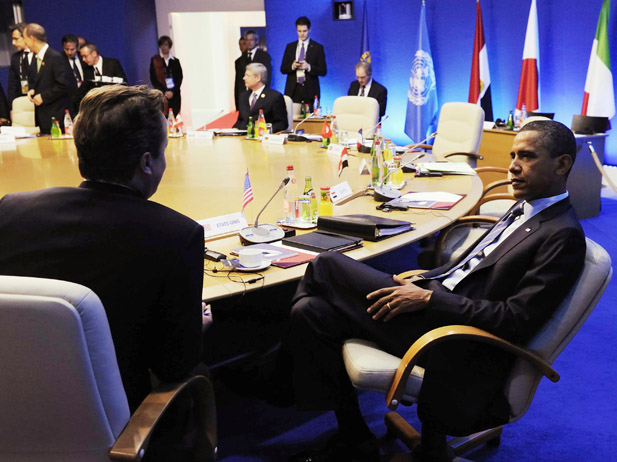
The United States and other members of the Group of Eight (G-8) industrial nations (Germany, France, Canada, United States, Britain, Italy, Russia, and Japan) are attempting to assist Europe’s financial crisis. 

President Barack Obama discussed the ramification during an upcoming meeting: “All of us are absolutely committed to making sure that the growth and stability and fiscal consolidation are part of the overall package.” However, many citizens from these European countries resist any financial solutions (i.e. austerity measures) that will take away their quality of life.

At the same time of dealing with the global financial crisis, each country seeks to increase exports of goods and spearheading job creation in their own countries. Therefore, foreign government officials are in a risky situation by supporting any international agreed solutions which are very unpopular with their own citizens. 

Since globalization has linked each country economically, Americans cannot escape either.  Regardless of the continent, people are looking for answers. Thus, countries must promote mutual financial interest internationally while keeping a pulse of their own self interest.   Therefore, countries with an isolationistic mindset will have a difficult time navigating in the future. 

Please share your opinion on this topic. 

 © 2012 by Daryl D. Green                                    


Leaders Value Moms on Mother’s Day

Here’s the reality.  Every great leader came from a woman.  Therefore, no one should  dismiss the influence of mothers on today’s leaders. With the media bombarding women with unrealistic expectations for mothers, it is any wonder that today’s mothers feel under huge pressures to be perfect.

Stay-at-home mothers feel guilt for not providing financially as it takes two people to make ends meet. Working mothers feel the guilt of attempting to balance a career and a family at the same time. 

Any person worth salt would recognize that mothers are often the glue that holds families together.  People don’t like other people talking poorly about their mother, even if she has many flaws.  In fact, no matter how unfit or imperfect your mother may be, she was still your mother.

Your mother might have been a bad cook. She might have been a drug abuser. She might have been a terrible person. However, her imperfections are not open to public scrutiny. This article examines a 21st century motherhood model in contemporary society.  

Good mothers are difficult to model. According to the US Census in 2008, there are over 82 million mothers in America. Many mothers go about their business with little regard for their impact on society. As a matter of fact, the value of a good mother is often forgotten, except for the customary card on Mother’s Day. Not all mothers are built the same when it comes to character.  

Some women are openly unfit or unprepared to be mothers. The notion of an unfit mother is a legal definition which may vary from state to state. However, an unfit mother may be defined as a mother who fails to take care of the   basic needs related to the physical, mental, and spiritual state of a child. 

For example, Susan Smith, who was from South Carolina, became the poster child for a bad mother. She had appeared on national television proclaiming that her two children had been kidnapped. In reality, Smith had driven her car into a lake, drowning her children. She had done this act in pursuit of her own adulterous relationship.

Smith was later convicted in 1995 and sentenced to life in prison for murdering her two sons, Michael Daniel Smith, 3, and 14-month-old Alexander Tyler Smith. Many individuals would point to her as an abusive or neglecting mother. Furthermore, there are so many famous women who are esteemed as the modern day feminist model, but these women often do not represent the ideal mother figure. 

Good mothers distinguish themselves with an unselfish behavior. They are the ones who go the extra mile so that everyone’s mental or physical condition is properly cared for.

In fact, true mothers put their families’ needs ahead of their own. Of course, this selfless image runs counter to the “ME” only culture. King Lemuel must have realized this fact when he outlined his motherhood model in Proverbs 31. 

The mother described in this passage is a loving wife, kindhearted mother, a champion of the oppressed, a business woman, a godly figure, and insightful advisor. The author notes about this woman, “Her children arise and call her blessed; her husband also, and he praises her.’” Therefore, character does count if an individual wants to use the right model for good motherhood. 

Today, many people take a good mother model for granted. Some people complain about their mothers and how they do not fit today’s media model of an ideal mother figure. These unrealistic expectations cause some women to despair because they do not fit this unrealistic expectation. 

When there is a mother of unique character in society, she should be celebrated and cherished. In the daily grind of living, many folks lose sight of the positive influence of the right kind of mother. A good mother creates a legacy for future generations. Let’s hope that the positive model will never be forgotten.

Please share your opinion on this topic. 

© 2012 by Daryl D. Green