Noriko Connects With Japanese Workforce

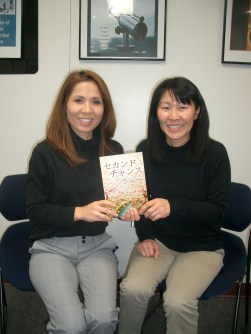
Reiko Farr & Noriko Chapman pose for new Japanese book.

 There is nothing more flattering to a professor than a student taking his academic advice and being successful.  This situation played out for me with one of my own MBA students this year. However, this week she took it to a different level.  

 For Noriko Chapman, it has created an international collaboration between a local U.S. nonprofit organization and a global leader in the automobile industry which led to the empowerment and economic independence of disabled workers.   

Chapman, who is a DENSO production manager, had worked with the Tennessee Rehabilitation Center (TRC) in Maryville to help increase its operations efficiency as part of her MBA project. In 2009, the Maryville TRC was ranked at eighth in contract sales in Tennessee.

Its mission is to provide services that help lead individuals who have a physical and/or mental disability to employment and are designed to meet individual needs.

However, Chapman’s goodwill had many unintended consequences. She has had four versions of her first book published in one year, which is impressive for a beginning writer. She pledged 30 percent of the book proceeds to this organization. Chapman also helped to restore $75K of government funding to the Center. Chapman became connected to this organization.  She observed, “I was inspired by the staff and by individuals with disabilities who were trying very hard to learn work skills and seek permanent employment.” 

Through her first book, she was able to bring more attention by the media and the public in general to this disability cause. In fact, it landed the TRC’s director an expense-paid visit to DENSO in Japan.

DENSO Corporation, headquartered in Kariya, Aichi prefecture, Japan, is a leading global automotive supplier with customers that include all the world’s major carmakers. With more than 200 subsidiaries and affiliates in 35 countries and regions (including Japan), DENSO had worked to assist the nonprofit organization with a contract that allowed disabled workers to earn income.  In reality, DENSO was offering these workers a second chance. Chapman had made this relationship possible.

For the month of December (2011), Chapman is on an international book tour in Japan with her new Japanese version of her book. She hopes her new book and tour will help women in Japan too: “Japan is a male-dominated society.  Even though the culture is gradually adopting to accommodate female workforce, the career advancement for women in Japan is still limited. The changes are not quick enough to satisfy thousands of bright, hard-working Japanese women.”

Chapman hopes to other corporations and organizations follow in DENSO’s footsteps and help provide second chances to those who need it around the world.

 Please provide your insight on this topic.

 © 2011 by Daryl D. Green                                    

 

Practicing Philanthropy

In most cases, individuals are not hurt by giving to others.  My co-author, Noriko Chapman, emailed me last week about royalties on our book, Second Chance, and how the funds would go to charity.  While I looked at this book as an opportunity to provide assistance for nonprofit organizations, it was her idea to leverage our written work over the long-term. 

Noriko, who is a DENSO production manager, selected the Tennessee Rehabilitation Center (Maryville) as part of her MBA project.  We pledged 30 percent of the book proceeds to this organization.  Noriko’s giving attitude helped the Center’s financial needs.

However, it provided unintended consequences by bringing more media attention to this cause and the public in general. In fact, it landed the Center’s director an expense paid visit to DENSO in Japan.  Therefore, philanthropy can start from small beginnings.

Individuals can build a philanthropist mindset when giving to organizations or people. Social responsibility is a buzzword in a society demanding more accountability from its corporate citizens.  Social responsibility speaks to a company’s stance on the way its managers and employees view their duty or obligation to make decisions that protect, enhance, and promote the well-being of stakeholders and society as a whole.

Gareth Jones and Jennifer George, authors of Contemporary Management, argue about the importance of social responsibility: “The way a company announces business problems or admits its mistakes provides strong clues about its stance on social responsibility.”

With the economic crisis, there are many institutions in trouble.  According to Merriman-Webster.com, philanthropy is defined as an act or gift done or made for humanitarian purposes. Most people associate philanthropy with the wealthy. 

However, philanthropy must start with a mindset and attitude for giving, regardless of where a person stands on the economic ladder.  Marc Benioff, Chairman & CEO of salesforce.com, built his organization with a philanthropy-focus.  Salesforce.com is a cloud computing company with a mission of ‘The End of Software.” 

Benioff has had a history of successful business ventures, including Oracle Corporation and Macintosh Division.  However, he noted for the achievement of designing a new philanthropy model.  The Salesforce.com Foundation aims to inspire companies across the globe to give 1% of their resources to support charities and social causes. Other companies like Google have embraced this model. 

This 1%; 1%; 1% philanthropy model includes one percent of company’s time, one percent of its equity, and one percent of its products donated to charity.  For Salesforce.com, this model means giving employees 6 paid days of volunteer time to use over the course of the year.  To date, Salesforce.com employees have donated over 178,000 hours.

The Salesforce.com Foundation has supported giving of products to 8,000 nonprofits in 70 countries.  On the equity front, one percent of founding stock is used to offer grants focused on technology innovation in nonprofits and youth development programs.  The company has given over $20 million in grants to qualified nonprofit organizations. 

Therefore, a philanthropist mindset can carry great rewards in sustaining meaningful programs in society.  It is not exclusive to the most wealthy people.  

Discuss your personal experiences on this topic.

© 2011 by Daryl D. Green