Beyond the Breakeven Point of Value Creation

Every year it’s my ritual to take off from work, join other professionals, and meet at a university for two days to share our corporate experience with undergraduate students. 

As my trademark routine, I love to engage the young group and gain insight on their future aspirations. Yet, I am saddened by the lack of student preparation for future employment opportunities.  Many of these students are graduating seniors who are not ready for the harsh realities of life (your parents won’t be able to sustain you forever). 

 Furthermore, most students are unaware of current events, how to utilize their career center, and what to do to gain the attention of prospective employers.  

Yes, I understand them! College is fun with few obligations and adult responsibilities for the average traditional student. It’s an opportunity to live like an adult without any sever consequences due to the fact that parents will continue to fund their college experiences and bail them out of most situations.

The problem is that today’s college students cannot afford to be unfocused during this economic crisis. If they are to be employed and enjoy life, college students, as well as most of us, must understand the upmost importance of creating value to our customers.

An advanced education can create value for prospective employees. According to Georgetown University’s Center on Education and the Workforce study, a college degree adds 84% to salary over a lifetime versus just a high school diploma. Individuals need to realize that like corporations they must understand their customers in order to build value for them.  

This concept isn’t easy because customers want different things. Value is defined as the net bundle of benefits the customer derives from a product or service.  Value creation focuses on an organization’s ability to convey the worth of its product or service to customers. 

Leaders must be attuned to value creation if a flow down is to take place throughout the value chain.  This is true even for new leaders. Michael Watkins, author of The First 90 Days, maintains that effective leadership seeks to add value as much as possible.

Watkins explains, “The breakeven point is the point at which new leaders have contributed as much value to their new organizations as they have consumed from it….new leaders are net consumers of value early on; as they learn and begin to take action, they begin to create value.”

John Gamble and Arthur Thompson, authors of Essentials of Strategic Management, further explored the concept of value as a strategic advantage. Businesses can create unique capabilities and valuable resources that rivals can’t easily duplicate. This includes companies launching a variety of strategies including low-cost, differentiation, or niche. The authors suggest, “Resource-based strategies may be used in tandem with any of the three strategic approaches…and are keyed to delivering customer value in ways rivals are unable to match.”

Regardless of the industry, value creations needs to be the cornerstone of any business strategy.  What’s important to the customer should be important to the businesses. College students, looking for future employment, should always keep this in mind in their job preparation.  If individuals keep the concepts of value creation in their mindset, they will be able to overcome many of the disruptive changes to come.

How does value creation relate to sustainability for today’s leaders?

© 2011 by Daryl D. Green

Will America Survive Global Changes?

 Being on vacation is a wonderful invention for humanity. Over the break from the daily grind, I went with my family to Navarre, Florida.  It was quiet and surreal.  I enjoyed walking the white sands in tranquility.  Yet, the Gulf environment also provided contradictory outlooks.

Once the water was clear as a mirror, now it was clouded by dead seaweed on shore. One boy celebrated finding a dead fish washed to shore.
I wondered what impact the oil spill had on the pristine environment.  The beaches showed evidence of commercialization as I saw trash (i.e. beer bottles, wrappers, etc.) abandoned on the beaches.  It made me wonder if the ocean was dead.

Can anything be sustained over time? Leaders falter across the globe, from the biggest to the smallest countries.  This month, world policy makers were unable to agree on fixes for their economy which sent investors on a wild ride for several weeks. Debts in Europe and the U.S. raise the question about the ability of political leaders to control ‘the trans-Atlanta panic.’ America’s on the blink?


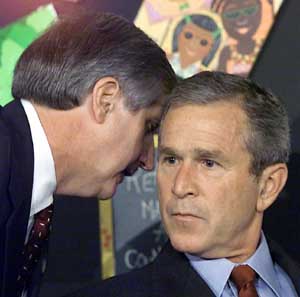
President Bush is notified of the September 11th Attacks.

In August, business empires were shaken.  For example, two industry leaders (Microsoft and Wal-Mart) struggle to sustain growth. On August
12, 2011, the two companies were added to the Dow Jones U.S. Contrarian Opportunities Index, which tracks stocks that “lag behind the broader market in
terms of recent performance, but outrank their peers based on fundamental and other qualitative criteria.

Yet, American businesses outsource abroad in order to impress investors and shareholders.  Corporate executives silently mock politicians, who desire them to pursue a business strategy of ‘creating jobs’ rather than an innate strategy of profitability.

U.S. political leaders, unable to break the ideology divide, lead financial investors on a wild goose chase with their indecision and create anxious and cynical citizens worried if they will be able to survive in the future.

Given these patterns of disruptive change, today’s institutions need strategic leaders with a clear view of sustaining success.  Over the next several months, I will focus on strategic leadership and sustainability concepts in order to assist the next generation of leaders obtain the necessary attributes to overcome unknown circumstances.

Andres Edwards, author of The Sustainability Revolution, views sustainability consisting of key components, ecology/environment,
economy/employment, equity/equality, and education. He notes, “Success requires an understanding of the complex forces at work, a vision of the future and a strategy for making the vision a reality.

How are the concepts of traditional leadership at odds with the concept of sustainability as it relates ecology/environment, economy/employment, equity/equality, and education?

© 2011 by Daryl
D. Green


Increased Profitability through Value Creation

As I listened to the radio, I couldn’t believe the amount of grid lock in the Washington, D.C. area.  Would both parties be so petty as to bring the nation to the brink of credit default? 

There were many people depending on government official to survive.  I turned the radio station to catch Dave Ramsey, national radio personality, go into a passionate appeal for Americans to take responsibility for their own lives and quit depending on the government. It sparked my attention.  Yet, what Dave Ramsey suggested was no easy matter.  How does an individual turn their ideas into a profitable venue?

Making money isn’t easy! People look for magical equations such as productivity equals outputs divided by inputs.  Decrease your inputs and you can expand your outputs.  Many businesses build their profitability on this simple equation.

Companies seek to reduce their inputs (outsourcing labor, better technologies) to obtain ‘more get.’ Yet, it’s pretty self-serving with little regard to the customer (places less value on employees too). Over the years, I have seen experts suggest that making millions is really easy if you have the right method. 

Loral Langemeier, author of the Millionaire Maker, has created her own version of a Wealth Cycle Process. She notes, “You can make the decision to make a lot of money at any age and in any stage of your life….No matter who and where you are, wealth building is well within your grasp. You just need to step up to the plate.”   Some of these processes may work. Yet, most are only ‘get-rich-quick’ schemes that leave people broken-hearted and empty pocketed!

Chris Anderson on the Long Tail Theory of Selling

Today’s profitability must be built on solving customer’s problems that have a financial value to them. What’s value?  It depends on the individual. Value is defined as the net bundle of benefits the customer derives from a product or service.  Value creation can be defined as an organization’s ability to convey the worth of its product or service to customers. Therefore, it goes to value, which focuses on the relationship between the customer’s expectations of the quality of a product/service quality to the actual amount paid for it. 

Mark Johnston and Greg Marshall, authors of Relationship Selling, argue that understanding customer needs should be the primary objective for profitable businesses.  Therefore, understanding the customer is the center point for creating value.

What has been your experience in turning ideas and concepts into profitable ventures?

 © 2011 by Daryl D. Green